Your first CFO hire: what to look for and what tools they will need on day one

- Link copied
The first CFO hire is rarely about hiring a CFO. It is about admitting that finance has stopped being a side function and started being a part of how decisions get made.
For most scaleups, that moment lands somewhere between US$5M and US$15M ARR, with three or four entities, two or three currencies, and a board that asks for a 13-week forecast every quarter and expects to find it ready whenever they ask.
The person you bring in is supposed to fix that. The challenge is that what you hire and what you give them to work with determine whether they spend their first 90 days building the function or rebuilding the foundation.
Is there an ideal CFO profile? It depends.
At Series A, the strongest first CFO hires share a few traits that are not always visible in a job spec.
They have operated, not just advised. A Big Four background can help, but what makes the difference is operating experience. The CFOs who scale a finance function from twenty people to two hundred have lived through the inflection points and made the calls. They know what breaks first when you open a new entity, when you onboard a new payment provider, and when the board moves from quarterly to monthly check-ins.
They are comfortable in software. The modern finance leader spends meaningful time in dashboards, APIs, and connected systems. A CFO who only knows Excel will spend their first quarter mapping your stack instead of running it.
They have multi-entity and multi-currency experience. The mechanics of intercompany flow, transfer pricing, FX exposure, and consolidation are learned on the job. A CFO who has done it once will not need to learn it again on your time.
They communicate with both your board and your team. The CFO who can explain runway scenarios to investors and also coach a junior finance hire on reconciliation discipline is the person you want. The work cuts in both directions.
What good CFOs expect on day one
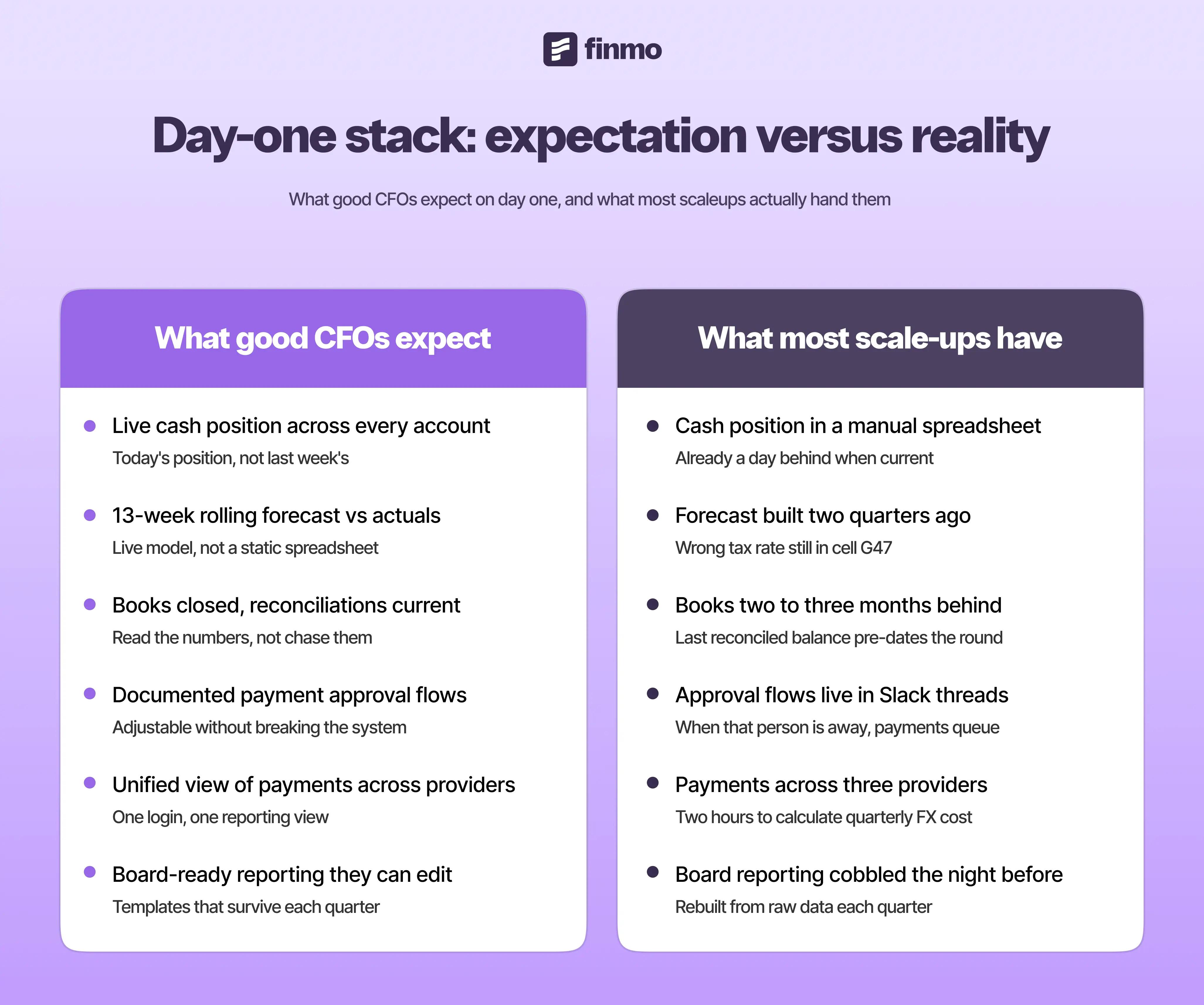
Strong finance leaders arrive with a clear picture of what they need to do their job. They expect to find:
- A live cash position across every account, entity, and currency. Today's position, not last week's.
- A 13-week rolling forecast that updates against actuals, not a static model someone built two quarters ago.
- Books that are closed for the last month and reconciliations that are current. They want to spend their first weeks reading the numbers, not chasing them.
- Documented approval flows for payments, expense claims, and contract signatures. They want to know who signs what at what threshold, and to be able to change it without breaking the system.
- A unified view of payments operations across providers, currencies, and corridors. One login. One reporting view.
- Board-ready reporting templates they can edit, not rebuild.
What most scaleups actually have
The gap is typically structural. In most scaleups at this stage:
- The cash position lives in a spreadsheet that someone updates manually each week. By the time it is current, it is already a day behind.
- The forecast is a Google Sheet that someone built in a hackathon two quarters ago. It still has the wrong tax rate in some cells.
- The books are two to three months behind. The last reconciled bank balance is from before the most recent fundraise.
- Approval flows live in someone's head or in a Slack thread. When that person goes on holiday, payments queue up.
- Payments run through three different providers. Nobody can tell you the total FX cost for last quarter without two hours of work.
- Board reporting is cobbled together the night before each meeting. The incoming CFO will rebuild the pack from raw data each quarter until they trust the inputs.
For more on the diagnostic signals that your cash visibility gap is becoming a problem, read 5 signs your startup has a cash visibility problem. For the broader picture of what scaleup-stage treasury infrastructure should look like, see our practical guide to treasury management for startups.
The 90-day reality
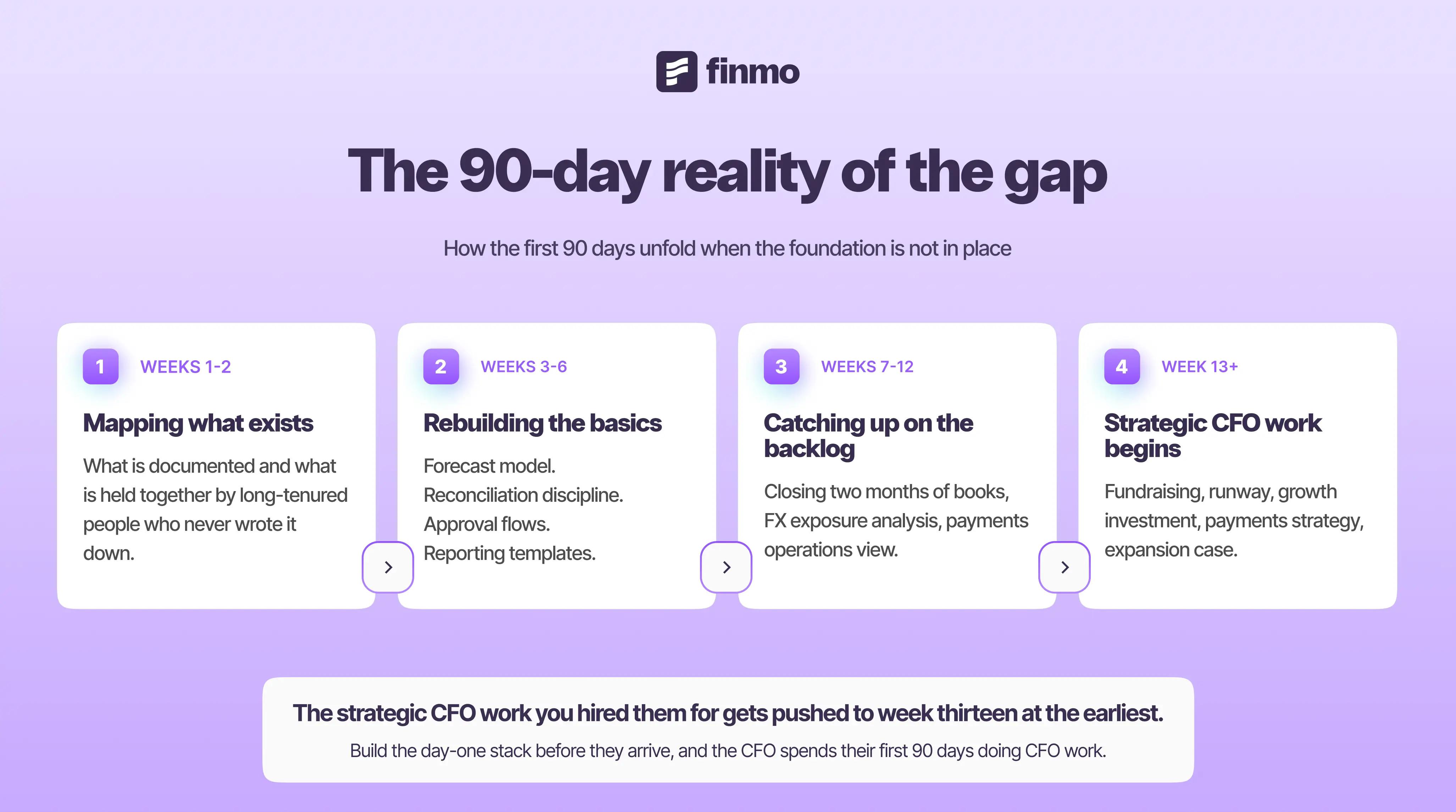
When a new CFO joins and finds this gap, the first 90 days typically unfold in a predictable pattern.
Weeks one to two go on mapping what exists, what is documented, and what is held together by one or two long-tenured people who have not written anything down.
Weeks three to six go on rebuilding the basic infrastructure that should have been there. Forecast model. Reconciliation discipline. Approval flow documentation. Reporting templates.
Weeks seven to twelve go on catching up on the actual backlog. Closing the last two months of books. Running the FX exposure analysis the board wanted last quarter. Building the first version of a payments operations view.
The strategic CFO work you hired them for, the fundraising preparation, the runway optimisation, the growth investment modelling, the payments strategy, the international expansion case, gets pushed to week thirteen at the earliest.
What a day-one-ready stack looks like
The scaleups that get the most out of their first CFO hire are the ones that have built the operational foundation before the CFO arrives. The shopping list is short and specific:
- Connected bank feeds across every entity and currency, surfaced in one live view.
- A treasury operating system that handles cash visibility, forecasting, payments execution, and FX exposure in the same platform. One stack, one source of truth.
- Reconciliation that runs against live bank feeds rather than CSV exports. Most of the work happens automatically, freeing the CFO to focus on the exceptions.
- Documented approval flows that the CFO can adjust without engineering involvement.
- A 13-week forecast that updates against actuals as the books close.
- Board-ready reporting that can be exported in minutes.
Every item on this list is available today, at a price point that fits a scaleup budget, in implementations that take weeks rather than quarters. The companies that get this right hand their new CFO a working foundation right out the gate. The CFO then spends the first 90 days doing the kind of CFO work you hired them to do.
What tool would a good CFO today choose?
The clearest signal of a scaleup that takes finance seriously is the stack the CFO walks into. If your incoming finance leader has to spend their first quarter rebuilding what the bookkeeper held together with spreadsheets, you are paying CFO salary for bookkeeper work – that is simply uneconomic.
Finmo was built as a platform any new CFO would choose if they were starting their finance function from scratch. We built it to connect to existing banks, accounting platforms, and payment providers, and to give modern finance leaders the visibility, forecasting, payments execution, FX management, and intelligence to thrive from day one. Implementation is sorted in days, and the price point fits a scaleup’s budget.
So go ahead and hire a CFO, but make sure you give them what they need to do the job they were hired for.
→ Read on Finmo Pulse: The new CFO playbook by David Hanna
FAQs
When should a scaleup hire its first CFO?
Most scaleups hire their first CFO between US$5M and US$15M ARR, typically when finance has stopped being a side function and started shaping how decisions get made. The trigger is rarely revenue alone. It is usually the combination of multiple entities, two or more currencies, and a board that wants a 13-week forecast as standard.
What's the difference between a CFO and a Head of Finance?
A Head of Finance runs the day-to-day mechanics: bookkeeping, payments, reconciliation, basic reporting. A CFO operates the function strategically: capital allocation, runway optimisation, fundraising preparation, international expansion modelling, board-level financial narrative. The two roles look similar at the title level. They differ in what the person spends their week doing.
What should you look for in your first CFO?
Operating experience over advisory experience, comfort with software and connected systems, multi-entity and multi-currency experience if you are already international, and the ability to communicate with both the board and a junior finance hire. A CFO who has done it once at a company of your stage will not have to learn it again on your time.
What tools should be in place before your first CFO arrives?
A live cash position across every account, a 13-week rolling forecast that updates against actuals, closed books with current reconciliations, documented approval flows, a unified view of payments across providers, and board-ready reporting templates. If the new CFO has to rebuild any of this, the first 90 days go on infrastructure instead of strategy.
What does the first 90 days look like for a new CFO?
When the foundation is in place, strategic CFO work begins in week one. When the foundation is not in place, the first six weeks go on mapping what exists and rebuilding basic infrastructure, weeks seven to twelve go on catching up the backlog, and the strategic work the CFO was hired for gets pushed to week thirteen at the earliest.
David Hanna is CEO and Co-Founder of Finmo, a treasury management system with embedded payments built for companies operating across borders. With over 20 years in risk and compliance at PayPal, EY, ING, and Rapyd, he has seen how treasury complexity breaks businesses at every stage of growth. Finmo is licensed and regulated across 8 jurisdictions globally.