A practical guide to treasury management for startups

- What is treasury management for startups?
- How treasury management should evolve at Series A and B
- The hidden cost of unmanaged FX exposure
- What does treasury management actually looks like in practice?
- The Growth Stage Liquidity Framework for Series A Startups
- Finmo helps startups streamline treasury management without the chaos
- FAQs
- Link copied
Most Series A and B startups run out of cash discipline, not opportunities. Treasury management can determine how durable your runway really is. This guide shows CFOs how to move from fragmented visibility and fragile forecasts to structured liquidity control, and how treasury management systems like Finmo enable real-time cash clarity without enterprise complexity.
Over 2 in 5 startups (38%) end up failing because they run out of cash. Many startup founders obsess over growth metrics, CAC efficiency, and hiring velocity, all the while liquidity management gets treated as a back office practice until it becomes the reason for the business’s stagnated growth.
Once you start operating across borders and move beyond a single currency account, treasury management becomes one of the few functions that can directly determine your startup’s runway durability and operational resilience.
This guide discusses where treasury complexity begins in scaling startups, the right way for CFOs to approach liquidity, and the practical steps to build stage-appropriate infrastructure without prematurely adopting enterprise systems.
What is treasury management for startups?
When startups finally get funding and institutional capital enters the picture, treasury stops being administrative and becomes strategic.
Stepping into the Series A phase, three structural changes occur:
- Balance size increases: Before the raise, your cash might be mainly covering payroll and vendor payments. But after the raise, you become responsible for allocating a significant balance over a defined runway and that introduces real decisions.
- How much cash should remain fully liquid?
- How much cash can earn yield?
- How much cash is needed in the next six months versus the next two years? - Operating setup becomes more complex: You may be opening new bank accounts, operating in multiple currencies, or setting up foreign entities to manage regional payroll and vendor payments. Cash is no longer sitting neatly in one place. It is spread across accounts, institutions, and sometimes countries. And of course, manual reconciliation and never ending spreadsheets only add to the problems.
- Scrutiny increases: Board members now expect clear answers about runway, liquidity buffers, and downside scenarios. Investors want to see disciplined capital management and not just growth. Your forecasts have to be accurate, updated, and defensible instead of just being optimistic.
Without structured treasury discipline, startups tend to oscillate between over-conservatism and operational fragility–but both constrain scale
How treasury management should evolve at Series A and B
Your treasury does not need to suddenly become sophisticated after a Series A or B. It needs to become structured around two clear priorities: visibility and execution control.
- Priority #1: Unified visibility
CFOs should be able to see consolidated balances in real time and rely on live data when forecasting runway, approving hires, or evaluating expansion. When cash is spread across multiple banks, currencies, and entities, a decision made on a number that's 48 hours stale is a decision made blind.
Companies with good cash forecasting can achieve over 90% of their estimated quarterly accuracy
- Priority #2: Structured execution
CFOs should be able to control how money moves, not just see where it sits. Payments should run through a centralised workflow with clear approval layers and embedded controls. FX impact should be visible before funds are sent and audit trails should be automatically recorded.
The hidden cost of unmanaged FX exposure
For startups operating across borders, burn rate is rarely a single number. It's a moving target.
Consider a Singapore-headquartered startup post-Series A. They're paying a 12-person engineering team in India in INR, running cloud infrastructure billed in USD, and covering a two-person sales team in the UK in GBP. Their board-approved monthly burn is SGD 400K.
But here's what actually happens: INR weakens 4% against SGD in a quarter. USD strengthens 3%. GBP swings on a policy announcement. None of these moves are large individually but combined, the effective burn rate shifts by SGD 20–30K per month without a single new hire or unplanned expense. Over six months, that's a runway miscalculation of 2–3 weeks that doesn't show up until the CFO reconciles manually at month-end.
This is the FX visibility gap. It's not about sophisticated hedging programs - that's an enterprise problem. At Series A and B, the priority is simpler: knowing your real burn in your reporting currency before payments go out, not after.
What does treasury management actually looks like in practice?
Once visibility and execution are stabilised, treasury becomes a capital allocation discipline. Let's take a look at what treasury management looks like in practice for startups
The Growth Stage Liquidity Framework for Series A Startups
Consider a Series A startup that has just raised $25M. Monthly burn is $750K, and leadership expects to deploy most of that capital over the next 18 to 24 months.
On paper, that's more than 30 months of runway.
Without structured treasury planning, the default response is predictable: keep the full $25M in a single operating account, preserve immediate access, and avoid perceived complexity. It feels safe, but what it actually does is leave capital efficiency entirely unmanaged. Idle cash earns nothing, and there's no structural separation between funds needed this month and funds not needed for two years.
The more disciplined approach is to segment liquidity by deployment horizon across three buckets:
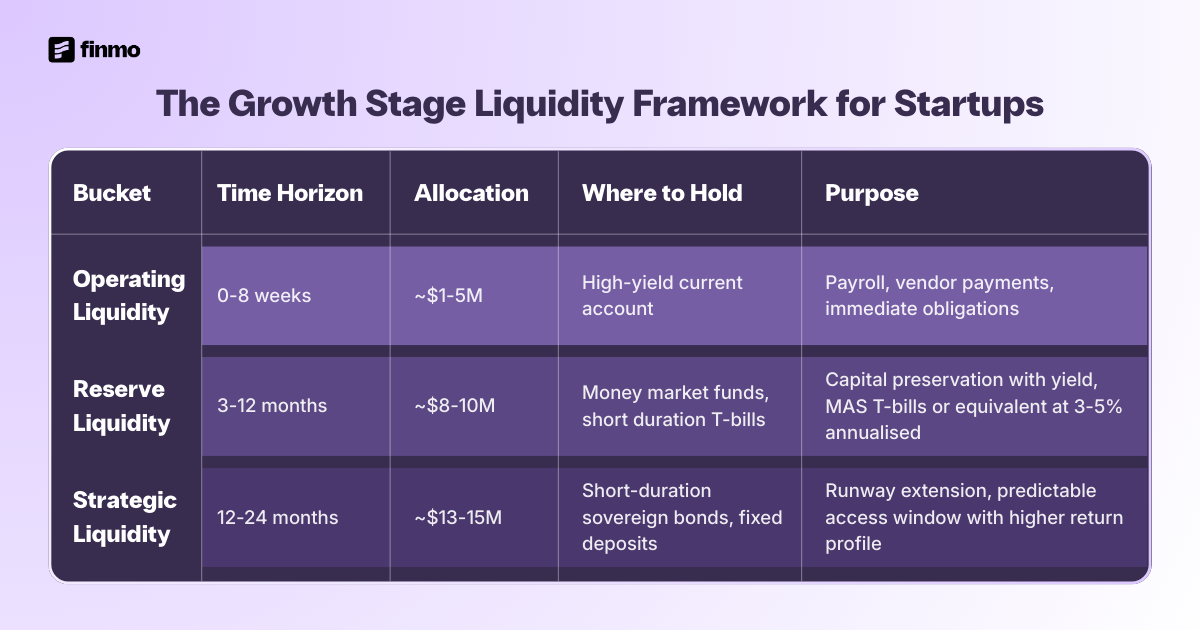
The goal isn't to maximise return. It's to ensure every dollar is working at the level of risk and accessibility appropriate to when it will actually be needed, while preserving your ability to move fast when the market shifts.
Finmo helps startups streamline treasury management without the chaos
Treasury management for startups breaks when growth outpaces your existing financial infrastructure.
It rarely happens all at once. It starts with a second bank account for a new entity. Then a third currency when you hire contractors abroad. Then a board meeting where your CFO spends the first ten minutes explaining why the runway number in the deck does not match the one in the bank.
At this stage, you don't need a complex enterprise TMS. What you need is a connected finance function: a single place to see all your cash, a reliable way to forecast where it's going, and controls that govern how it moves.
Finmo is built specifically for startups at this stage. It replaces fragmented bank portals and spreadsheet reconciliation with a real-time treasury layer, without a six-month implementation cycle.
For Series A and B companies, Finmo enables:
- Real-time balance aggregation across banks, currencies, and entities
- Direct API connectivity to banks, ERP, and accounting systems
- Automated reconciliation and intelligent transaction categorisation
- Dynamic forecasting powered by live transactions, receivables, and payables
- Scenario modelling to stress-test hiring plans, delayed revenue, or cost shocks
- Streamlined cross-border payments with real-time FX visibility before execution
Sign up in under two minutes with no changes to your existing banking setup required.
FAQs
1. How do I get real-time visibility into cash across multiple bank accounts?
Real-time visibility requires connecting all your bank accounts across currencies, entities, and countries into a single system. Instead of downloading statements and updating spreadsheets, startups can use treasury management systems like Finmo that aggregate balances and transactions via direct API connectivity. This creates a consolidated, real-time dashboard so CFOs can see total available liquidity instantly, without waiting for manual reconciliation.
2. How do I improve cash flow forecasting accuracy for my startup?
Forecasting accuracy improves when projections are powered by live data instead of static spreadsheets. Spreadsheets become outdated quickly as transactions clear, invoices shift, and FX rates fluctuate, creating version mismatches and manual errors. Treasury management platforms like Finmo connect directly to your banks, ERP, and accounting systems to generate dynamic forecasts from real-time transactions, receivables, and payables. This enables scenario modelling and produces forecasts that CFOs can defend in board discussions.
3. How should a startup manage cash after a Series A raise?
After a Series A raise, startups should segment liquidity by deployment horizon rather than leaving all capital in one operating account. Typically, this means maintaining an operating buffer for near-term expenses, allocating medium-term funds to low-risk yield instruments, and aligning longer-duration capital with planned deployment timelines. The objective is disciplined runway management, not aggressive yield chasing.
4. What treasury management software do startups use?
Most Series A and B startups do not need enterprise-grade treasury systems yet. Instead, they can use treasury management platforms like Finmo that provide real-time bank aggregation, forecasting, and structured execution controls without heavy implementation overhead. Finmo connects directly to your banks and finance stack, improves liquidity visibility, and scales with complexity rather than introducing unnecessary process burden.
5. How do I reduce manual reconciliation and bank reporting for my finance team?
Manual reconciliation is time-consuming and error-prone, especially as transaction volume and bank accounts increase. Treasury management platforms like Finmo automatically aggregate transactions, match data, and categorise cash flows in real time. This eliminates constant statement downloads and spreadsheet updates, allowing finance teams to focus on forecasting, liquidity planning, and strategic analysis instead of formatting reports.