What CFOs are searching for in 2026 and what it says about the finance function
- Link copied
What people search for tells you what they are trying to solve. For the past decade, what CFOs searched for stayed remarkably stable. Annual budgeting templates. P&L analysis. Audit preparation checklists. The vocabulary of a function that was largely retrospective, largely reactive, and largely defined by the calendar.
That has shifted in the past eighteen months. The search queries finance leaders are running today look different. They reveal a function in transition, and the direction of the change is consistent across markets and company sizes.
Three patterns in the data are worth surfacing. They map to what we hear from finance leaders at scaling companies every week.
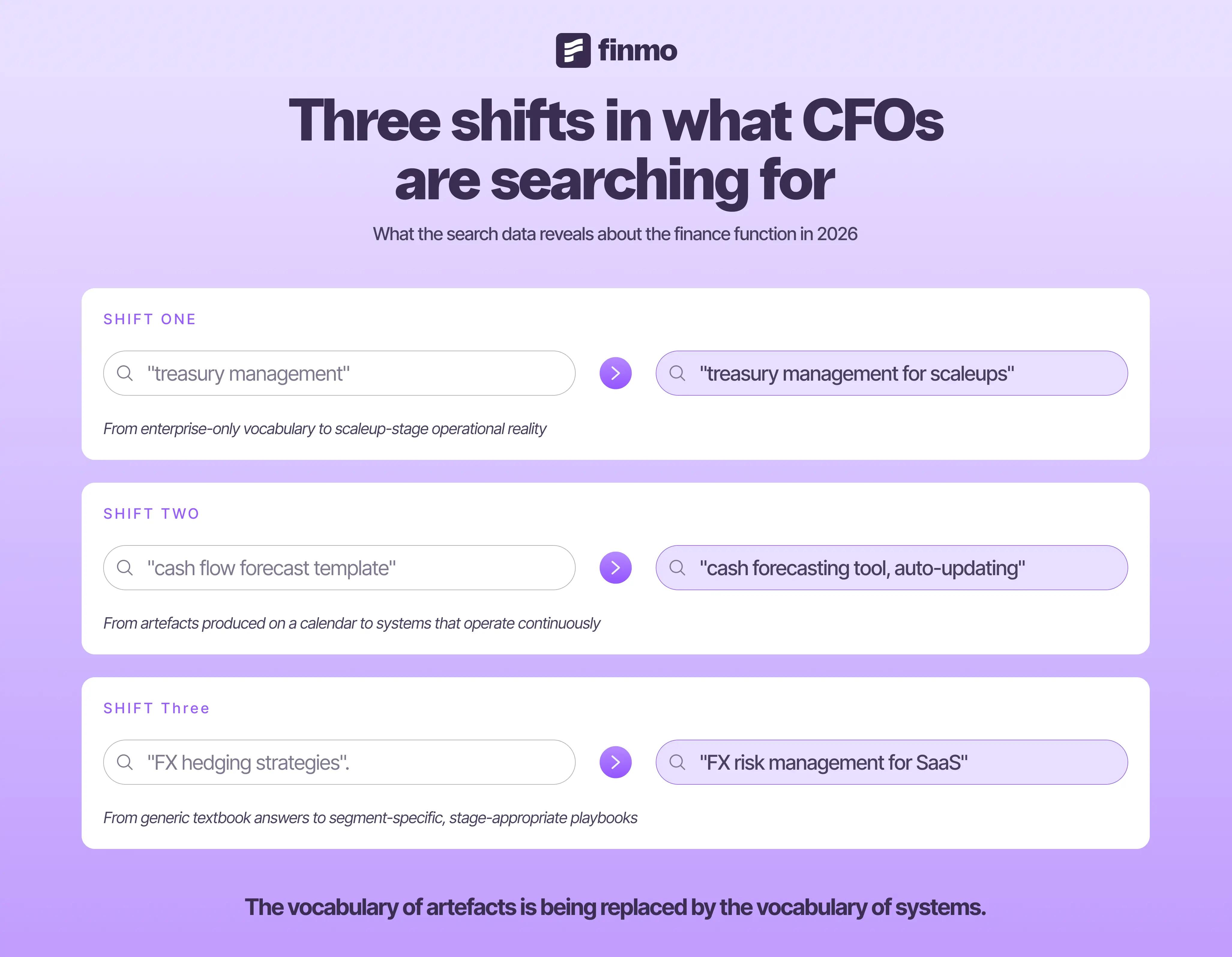
Three shifts in CFO search behaviour, each pointing to the same underlying movement in finance
Shift one: From treasury management to treasury management for scaleups
The search term “treasury management” used to be enterprise territory. Anyone querying it was either at a Fortune 500 or working for one. The vocabulary belonged to a category of platforms that cost six figures a year and took twelve months to implement.
That has changed. The fastest-growing query patterns now pair “treasury management” with qualifiers like “for startups,” “for SMEs,” “for scaling companies,” and “lite.” The audience asking the question has expanded beyond the enterprise. Founders and Series A CFOs are using language that, three years ago, would have signalled they were shopping in the wrong category entirely.
The reason is simple. The companies that used to skip treasury management as a concept are now hitting its operational triggers earlier. A Series A scaleup with three entities, two currencies, and a US$50 million revenue run-rate has exactly the same treasury complexity as a small enterprise of a decade ago. Smaller companies are running enterprise-scale finance operations.
The category name democratised. The underlying need was always there.
Shift two: From forecast template to forecast tool
The other meaningful shift in search behaviour is the move from artefacts to systems. The query “cash flow forecast template” has been a long-running staple of finance search. It still ranks. The queries growing fastest in the same neighbourhood are different in kind. Searches for “cash forecasting software” have overtaken “cash flow forecast template” in several mid-market finance keyword clusters over the last 18 months. Query modifiers such as “for startups,” “for SaaS,” and “for scaleups” are increasingly appearing alongside treasury-related searches that historically belonged to enterprise finance teams
The shape of the question has changed. Finance leaders are no longer looking for a static document they will fill in once a quarter. Many finance teams are now forecasting across fragmented ERP systems, disconnected bank accounts, and multiple entities that were never designed to operate as a single financial layer. They are looking for a system that maintains itself between board meetings, integrates with their actuals, and surfaces the forecast as a live answer rather than a periodic exercise.
This is the visible edge of a bigger move. Finance functions are migrating from artefacts they produce on a calendar to systems they operate continuously. The Google search for “template” was the artefact era. The Google search for “tool” is the system era.
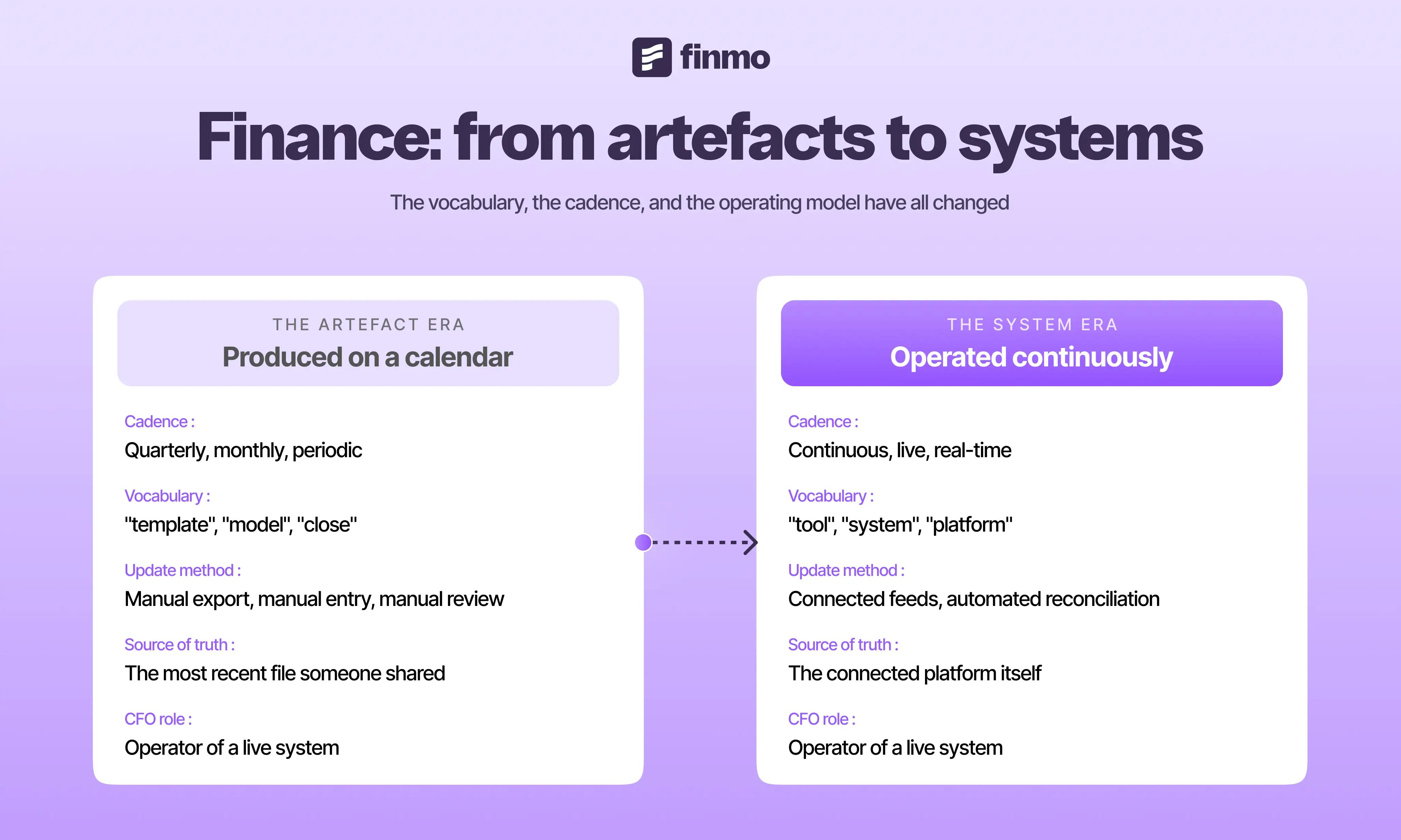
The vocabulary, the cadence, and the operating model have all changed
Shift three: From FX hedging to FX risk management for SaaS
Specificity is rising. The traditional finance query was generic. “FX hedging strategies.” “FX risk management.” “Treasury policy template.” The queries growing now are segment-specific. “FX risk for software companies.” “Multi-currency cash management for scaleups.” “Cross-border payments cost benchmark SaaS.”
Finance leaders are no longer looking for a textbook answer. They want the answer that fits their business model, their geography, their stage, their commercial reality. They want to know what other SaaS companies of their size do, instead of what an enterprise treasury manual recommends.
This specificity points to a function that is more confident in its own context. The CFO who searches “FX risk management for SaaS” knows what their problem is. They are looking for a peer benchmark or a stage-appropriate playbook, not a starting framework.
What the patterns tell us
Read together, the three shifts describe the same underlying movement in finance.
The function is more specific. Finance leaders are asking sharper questions about their own context, not learning the category from scratch.
The function is more continuous. The vocabulary of artefacts is being replaced by the vocabulary of systems.
The function is more democratised. The tooling and language of enterprise treasury are now used by Series A scaleups.
These changes do not arrive evenly. The CFO at a 50-person Series B in Singapore will be ahead of the CFO at a 200-person Series C in another market by the shape of the questions they are asking. The search data shows the leading edge of the movement, not its full distribution.
Why this matters for visibility
The same shift is happening on the AI side. When finance leaders ask a question of an AI model, the answer they get depends on what content the model surfaces. Generic treasury content from enterprise vendors ranks for enterprise queries. The content that ranks for “treasury management for startups” or “13-week forecast tool for scaleups” is being built right now, by the platforms and practitioners who understand that audience.
For CFOs at growing companies, this means the next decade of finance reference content is being written in the next eighteen months. The platforms that contribute to it will define how the function is described going forward.
For founders and finance leaders reading this, the practical implication is direct. The shape of your search history is also the shape of your operational maturity. If your queries still read like 2020, the function is not yet in 2026.
The ascendant CFO
The collective signal is consistent. Finance is becoming a function that runs continuously, asks specific questions, and operates with tools and language previously reserved for enterprise. The role of the CFO is moving with it, from cost centre custodian to growth-enabling operator.
It helps to name the two profiles directly, because the distance between them is what the search data is really tracking.
Traditionally, CFOs worked to the calendar. The budget was set once a year and revisited at quarter end. The forecast was a document built in a spreadsheet, accurate on the day it was finished but decaying immediately after. Cash visibility meant logging into each bank portal in turn. The job was to report the past accurately and stay ready for audit, and success was a clean close. This CFO sat downstream of the business, counting what had already happened.
The ascendant CFO works to the live position. The forecast is a system that updates against actuals, so the number on screen is current, refreshed as transactions clear. Cash across every entity and currency resolves in a single view. The remit runs well past reporting into capital allocation, runway, pricing, the international expansion case, and the payments strategy that protects margin as the business grows. A clean close is assumed, and success is measured by the quality of the decisions the function enables. This CFO sits alongside the CEO, shaping what happens next.
We built Finmo for this ascent of the modern CFO. The platform connects to existing banks, accounting systems, and payment providers, and gives growing finance teams the visibility, forecasting, and execution capability that, until recently, was only available to enterprises with six-figure budgets.
FAQs
What is a modern CFO?
The modern CFO operates the finance function continuously rather than producing artefacts on a calendar. They work with connected systems for cash visibility, forecasting, and payments. They speak the vocabulary of tools and platforms instead of templates and models. And they own a wider remit than their predecessors: capital allocation, growth investment, international expansion, payments strategy.
Why are CFOs searching for 'treasury management for scaleups' instead of just 'treasury management'?
Because the category has democratised. The companies that used to skip treasury management as a concept now hit its operational triggers at Series A. A scaleup with three entities, two currencies, and a US$50 million revenue run-rate has the treasury complexity of a small enterprise a decade ago, and CFOs are searching accordingly.
What is the difference between a cash flow forecast template and a cash forecasting tool?
A template is a static artefact you produce on a calendar, usually once a quarter. A tool is a system that updates continuously, integrates with actuals, and surfaces the forecast as a live answer. The shift from template to tool is the move from periodic artefact to continuous system.
How is the CFO role changing in 2026?
The role is shifting from custodian of historical artefacts to operator of a live financial system. CFOs at growing companies are increasingly running their function with the same tools, language, and operating cadence as enterprise treasury teams a decade ago, at price points and implementation timelines that fit a scaleup budget.
What does it mean that finance is moving from artefacts to systems?
It means the deliverables of the finance function are changing in kind. The artefact era produced static documents on a periodic cadence. The system era operates a connected platform continuously, with visibility, forecasting, and payments updating against live actuals. The back-office-to-control-tower migration is now visible in the search data.
Mansi Chopra is Chief Marketing Officer of Finmo, a modern treasury operating system with embedded payments built for companies operating across borders. With over a decade in global payments marketing at Nium, Thunes, and Ant International, she has watched the language and behaviour of finance leaders shift as treasury moves from back-office function to strategic infrastructure. Finmo is licensed and regulated across 8 jurisdictions globally.