Cash flow forecasting vs visibility: What comes first?

- Link copied
Series A/B startup and scaleup CFOs often treat cash visibility and cash flow forecasting as separate priorities, but in reality, they are directly connected.
As companies scale across markets, entities, and bank accounts, the pressure to forecast cash accurately continues to rise. In 2025, 34% of companies said cash forecasting is now significantly important, up from 19% in 2018, and 76% of leaders expect greater forecast accuracy.
But without real-time cash visibility into balances, receivables, and payables, forecasts just become an exercise in estimation. New-age treasury platforms like Finmo connect your banks, ERPs, and financial systems into one place, so CFOs can see their cash in real time and get the data they need for reliable forecasting.
What is cash flow forecasting?
Cash flow forecasting is the process of estimating how cash would possibly move in and out of a business over a specific period of time. The goal is to understand future liquidity positions so finance teams can ensure the company has enough cash to meet obligations while continuing to invest in growth.
A typical forecast combines data points including:
- Expected customer payments (accounts receivable)
- Scheduled vendor payments (accounts payable)
- Payroll and operating expenses
- Tax obligations
- Debt repayments or credit facility usage
- Planned capital expenditures
When forecasting works well, CFOs can make decisions with confidence. Finance leaders can evaluate hiring plans, assess expansion strategies, and ensure that the organization maintains sufficient liquidity to meet its obligations.
More than 53% of treasury teams say forecasting is challenging, and 72% say they would spend more time improving forecasts if better tools were available.
What is cash visibility?
Cash flow visibility refers to the ability to understand your organization’s cash position in near real time.
Finance teams get a real-time and consolidated view of how cash is moving through the organization, including:
- Cash balances in different bank accounts across various currencies and countries
- Cash inflows, such as customer payments, sales receipts, investments, and financing
- Cash outflows, including vendor payments, payroll, operating expenses, debt repayments, and other financial obligations
- Upcoming receivables and payables that affect short-term liquidity
This consolidated view allows CFOs to understand their true liquidity position at any given moment, make better decisions, and build forecasts on a much more reliable foundation.
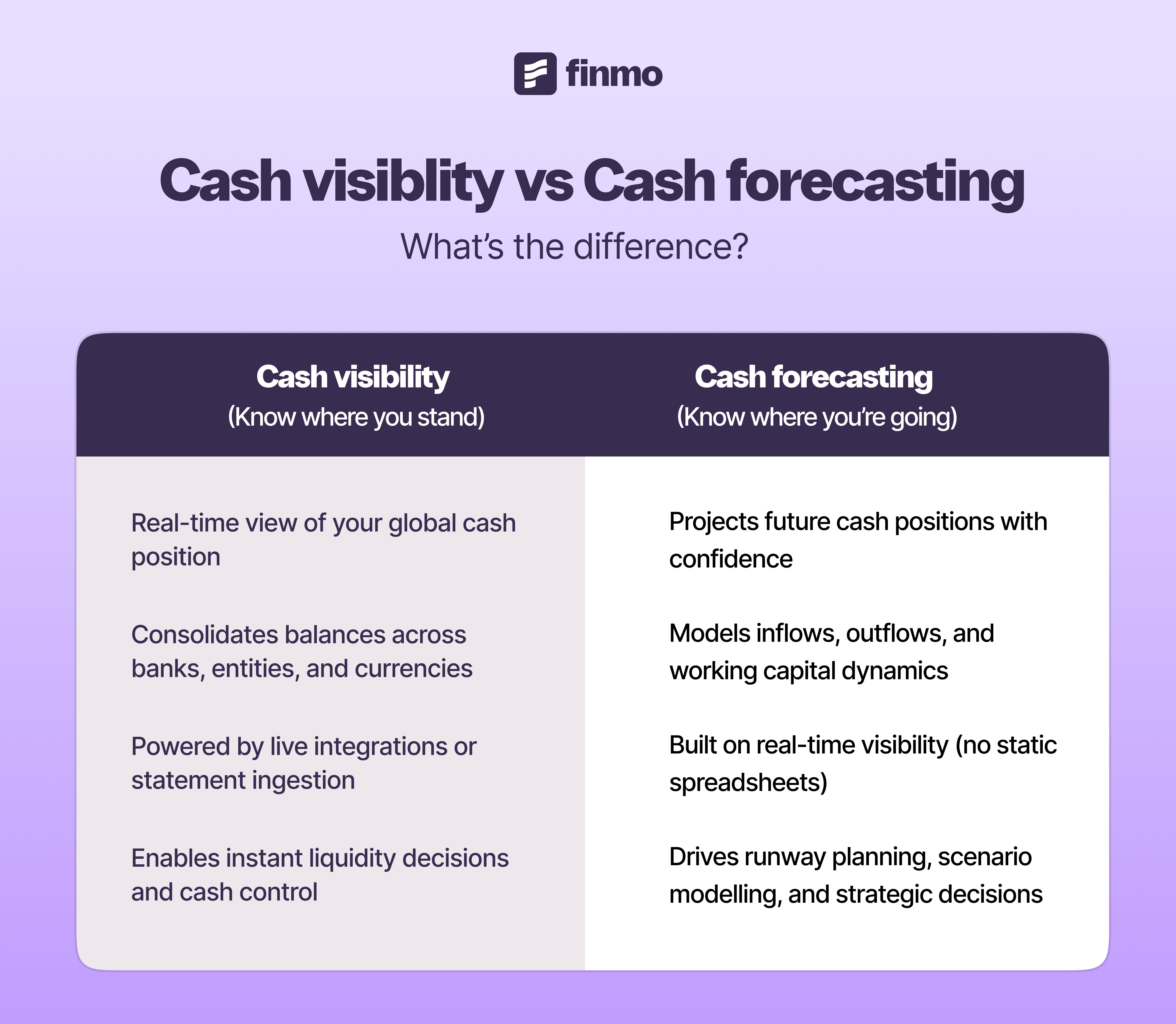
Cash visibility vs cash forecasting: What’s the difference?
Although the terms are often used together, cash visibility and cash forecasting serve different purposes.
Why cash visibility usually come first?
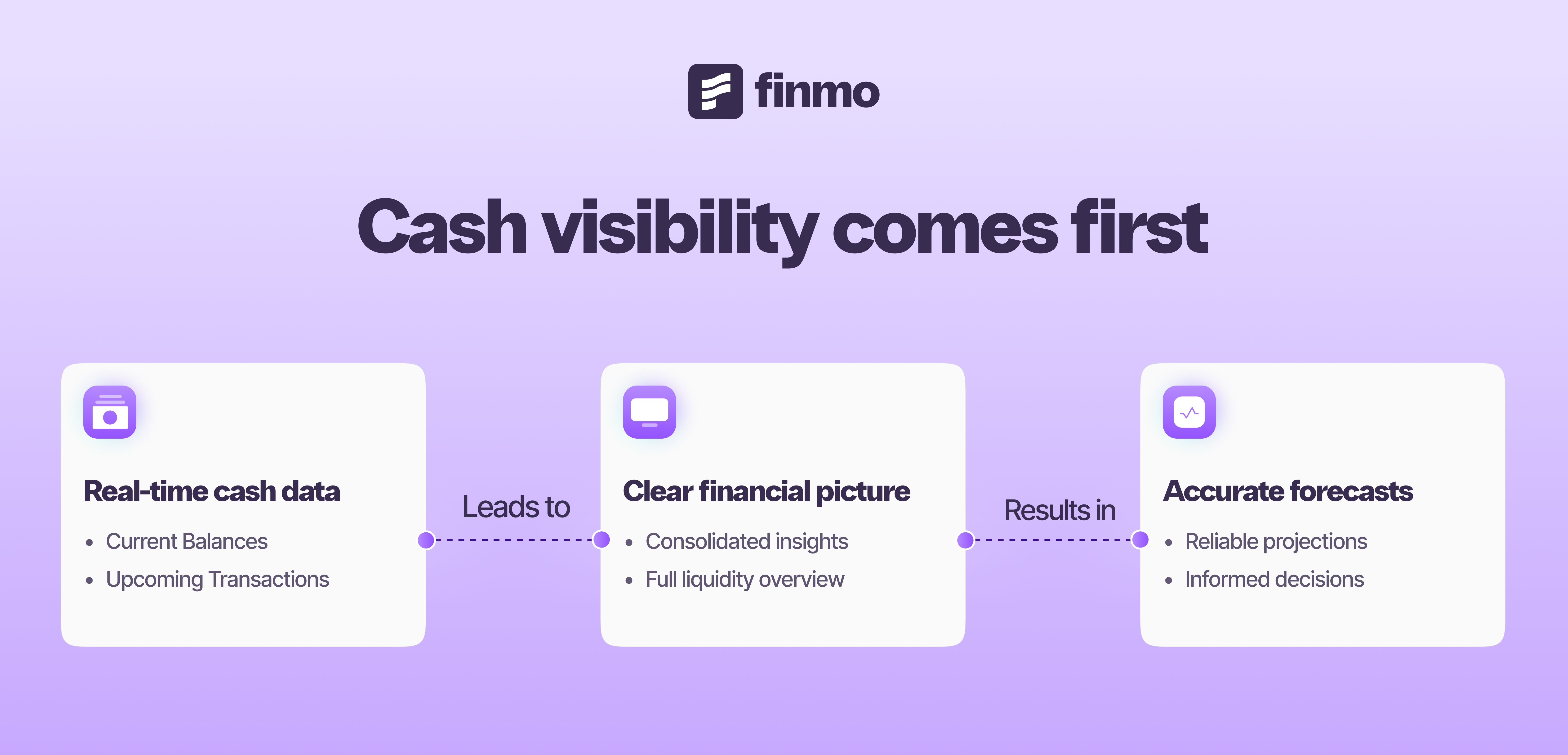
Before finance teams can project future liquidity, they need a clear understanding of the company’s current cash position and upcoming cash movements.
But if this information is incomplete or outdated, even the most advanced forecasting models will end up producing unreliable results.
For example, a startup estimating runway using two weeks-old bank data or incomplete receivables information may significantly miscalculate its projected liquidity. Even small errors in the underlying data can distort forecasts and lead to incorrect assumptions about how much cash the business actually has available.
This is why cash visibility has to come before forecasting maturity. Startups that invest first in improving cash visibility, by consolidating financial data and maintaining a real-time view of liquidity are better positioned to build accurate and actionable cash forecasts. The question then becomes: what does it actually take to get there, and what separates startups that achieve it from those that remain stuck in spreadsheet-driven guesswork?
Why do startups struggle with cash visibility?
For most scaling startups, the gap isn't awareness. Finance leaders already know visibility matters. The real barrier is structural. As companies expand across markets, their financial data fragments faster than their teams can consolidate it. Three compounding factors make this especially difficult to solve with existing tools.
Fragmented financial systems
Cash data typically lives across multiple systems including bank portals, ERP platforms, payroll tools, and payment processors. Without an integrated treasury system, finance teams are forced to manually pull and consolidate this information.
Spreadsheet-heavy workflows
Once the data is collected, it usually ends up in spreadsheets. While spreadsheets work for basic tracking, they quickly become difficult to maintain as transaction volumes grow. By the time balances are reconciled, the cash view is already outdated.
Multi-entity and multi-currency complexity
Scaling startups often operate across multiple entities, countries, and currencies. It can introduce challenges such as FX exposure, separate banking relationships, and fragmented balances across regions. As a result, cash ends up scattered across accounts, making it harder for finance teams to understand the company’s true liquidity.
Solving these challenges requires more than a better spreadsheet or an additional bank integration. It requires a connected financial infrastructure–one that pulls live data from across your banking relationships, ERPs, and accounting systems into a single, continuously updated view. This is the foundation that makes accurate forecasting possible. And it's the problem Finmo was built to solve, specifically for startups scaling globally, where complexity compounds faster than traditional treasury tools can keep up.
How Finmo helps CFOs achieve cash visibility and forecasting
For many scaling startups, the challenge isn’t understanding the importance of cash visibility or forecasting, it’s building the infrastructure needed to support both.
Finmo is a treasury management system built specifically for startups scaling globally. Instead of forcing finance teams to adopt complex enterprise treasury software, Finmo provides the core capabilities startups need to manage liquidity, forecasting, and payments through a single connected system.
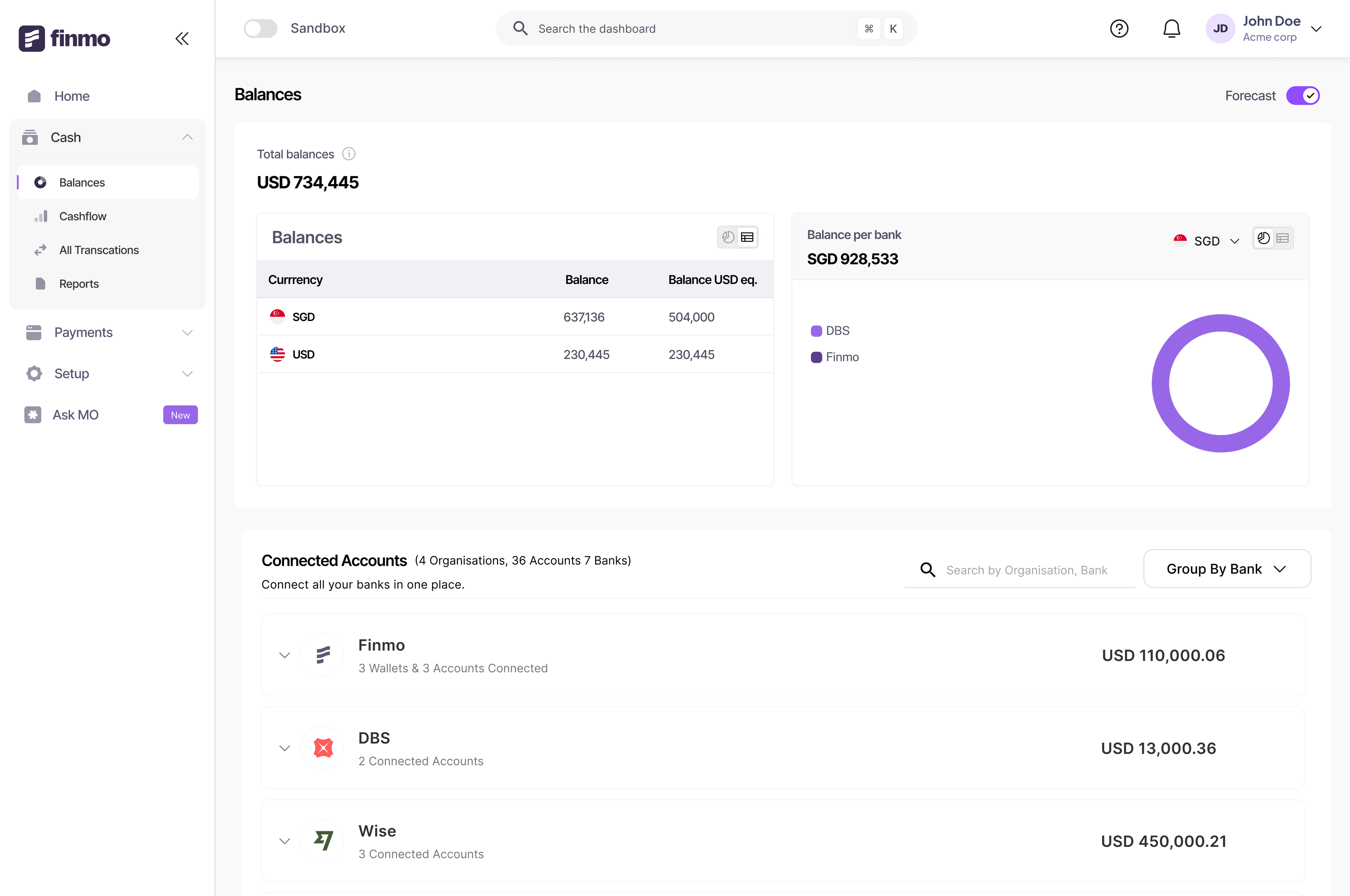
Real-time global cash visibility
Finmo’s connected treasury platform aggregates financial data across banks, ERPs, and accounting systems to create a unified view of liquidity. CFOs gain continuous visibility into:
- Where cash sits across bank accounts and currencies
- How liquidity is moving across entities and accounts
- FX exposures across currencies that may require hedging
- Upcoming receivables and payables that affect working capital
With this consolidated view, startup CFOs can answer investor and board questions faster, monitor runway more accurately, and make liquidity decisions with greater confidence.
Dynamic cash flow forecasting
Finmo’s cash flow forecasting engine combines live financial data, including bank transactions, invoices, receivables, and payables to generate continuously updated liquidity projections.
With Finmo’s dynamic cash flow forecasting, CFOs can:
- Project future cash positions using real-time financial data
- Model scenarios such as delayed customer payments, accelerated hiring, or unexpected expenses
- Adjust forecasting assumptions and instantly visualize the impact
- Enable scenario simulation to test best- and worst-case outcomes and compare them side by side
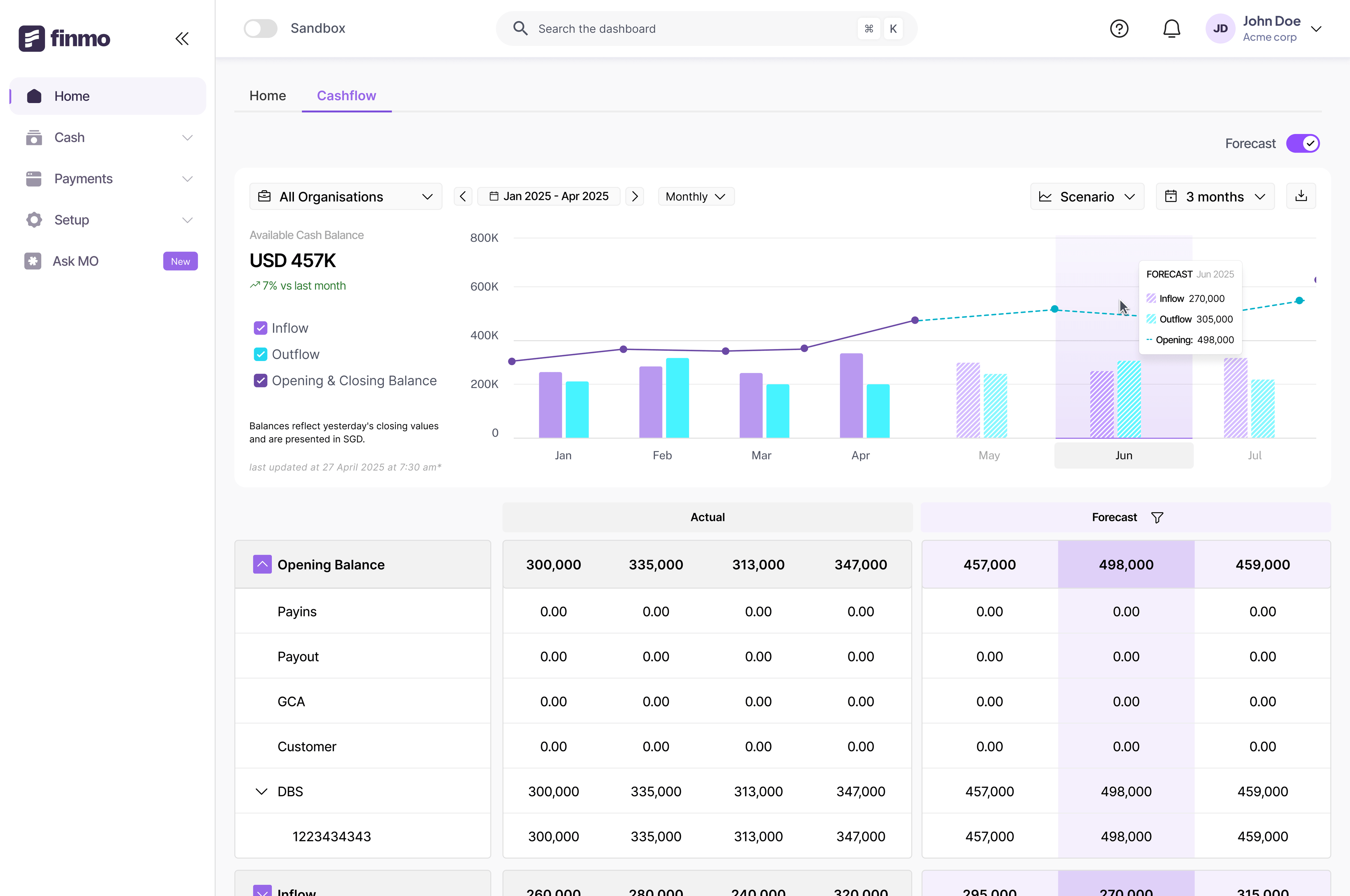
The result is a single, cohesive view of both current liquidity and future cash positions, allowing finance teams to move from reactive cash monitoring to proactive liquidity planning.
Connect your accounts and start managing your treasury with real-time visibility and accurate forecasting in minutes.
FAQs
What is the difference between cash visibility and cash flow forecasting?
Cash visibility involves understanding your company’s current cash position in real time, including balances, inflows, and outflows across accounts and entities. Cash flow forecasting, on the other hand, focuses on predicting future cash movements over a specific time horizon. In practice, forecasting depends on accurate visibility.
Why is real-time cash visibility important for startups?
Real-time cash visibility helps CFOs track liquidity across multiple bank accounts, entities, and currencies. This visibility allows finance teams to monitor runway, manage payments, and respond quickly to changes in cash flow. Without a clear and up-to-date view of cash, leadership teams may make decisions based on outdated information.
How can startups improve cash visibility and forecasting?
Startups can improve cash visibility and forecasting by consolidating financial data across bank accounts, ERPs, and accounting systems into a single platform. Treasury management systems like Finmo automate reconciliation and provide real-time dashboards, allowing finance teams to track liquidity and generate dynamic forecasts without relying on spreadsheets.
How do startups improve cash flow forecasting accuracy?
Startups improve forecasting accuracy by building forecasts on real-time, reliable data instead of static spreadsheets. This includes integrating bank accounts, accounting systems, and payment data into a single source of truth. Finance teams should also regularly update assumptions, track forecast vs actuals, and run scenario analyses to account for uncertainty.
How does treasury software help with cash forecasting?
Treasury software like TMS can improves cash forecasting by automatically aggregating financial data across systems and updating forecasts in real time. Instead of relying on manual inputs, finance teams get dynamic projections based on live cash positions, receivables, and payables. This allows CFOs to model different scenarios, respond quickly to changes, and make more confident liquidity decisions.