Finmo vs enterprise TMS platforms: What's the actual difference?
- Link copied
If you're a finance leader at a growing global company, you have probably looked at treasury software and walked away unsure about what actually fits.
Enterprise TMS platforms can feel like an overkill at this stage. But at the same time, spreadsheets, bank portals, ERP reports, and manual reconciliations are clearly not the answer anymore. So what is?
The honest answer is that it depends on where your company sits, and this is a question of fit, not which platform is universally better.
A multinational with a dedicated treasury team is managing debt portfolios, derivatives, hedge accounting, and in-house banking structures across dozens of entities. A full enterprise TMS exists for that reality, and it's the right tool for it.
Your reality at a growing global company that doesn’t operate with enterprise complexity yet is different. You are entering new markets, moving money across borders, reconciling cash in multiple currencies, and doing it with a lean team and no dedicated treasury support. You don't have 12 months and a team of consultants to spend on implementation. What you have is a set of operational questions that land on your desk every week:
- Where is our cash right now?
- Can we see balances across banks, entities, and currencies?
- Can we pay vendors and employees globally without switching between systems?
- Can we manage approvals and controls without slowing the business down?
- Can we forecast cash using live operational data?
That is the gap Finmo is built to close. Finmo is a Treasury Operating System (TOS) that gives growing companies real-time cash visibility, multi-currency payments, FX access, approval workflows, reconciliation, and financial controls in one platform, without the complexity of a full enterprise TMS. It sits alongside your ERP and accounting tools as the operational layer your finance team uses to run treasury day to day.
In this article, we break down where each category fits, where they diverge, and how to figure out which model matches your stage.
Finmo is a Treasury Operating System (TOS). Here's what that means
The term "TMS-Lite" is sometimes used to describe platforms that sit between spreadsheets and full enterprise treasury management systems. But "lite" is misleading. Finmo isn't a stripped-down version of an enterprise TMS; it's built around a different operating model entirely.
Finmo is for CFOs, controllers, finance managers, and treasury operators who are hands-on in the business. You may not have a dedicated treasury department, but you still need to manage cash, payments, FX, approvals, and reporting across markets, and you need that control before your operations reach enterprise complexity.
Finmo sits alongside your ERP and accounting tools as the operational treasury layer. You connect bank accounts, centralise cash visibility, initiate and track payments, manage FX, configure approvals, reconcile transactions, and monitor cash positions from one platform. Instead of switching between bank portals, spreadsheets, and disconnected systems, your team runs core treasury operations from one place.
The outcome: better visibility, stronger controls, faster execution, and less manual work.
What Finmo helps finance teams do
1. See cash across banks, entities, and currencies
When you hold cash across multiple banks, currencies, and entities, even basic questions get hard to answer.
- How much cash do we actually have?
- Where is it sitting?
- Which balances are available?
- Which accounts are underutilised?
- Which currencies are we holding more of than we need?
Finmo brings every bank account and balance into a single view. You don't log into multiple portals or wait for someone to update a spreadsheet to know your position.|For CFOs and finance leaders, this matters because cash visibility is the foundation for better decision-making, board reporting, runway planning, and payment timing.
2. Execute global payments in 40+ currencies to 180+ countries
Finmo lets you initiate and track cross-border payments in 40+ currencies to 180+ countries from one platform. International vendor payments, payroll, and intercompany transfers all run from the same workflow with no fragmented systems or handoffs to a separate payments tool.
Most treasury platforms are visibility, workflow, or connectivity layers and rely on banks or payment partners for the actual money movement. Finmo's model is different as it’s a licensed and regulated payment institution across multiple jurisdictions, it sits directly in the funds flow, not as a visibility layer on top of someone else's banking infrastructure. So, you can manage both treasury visibility and payment execution within a single operating environment.
3. Manage FX with more control
For companies operating across borders, FX shows up in daily operations. You're collecting in one currency, holding balances in another, paying vendors in a third, and reporting financials in a fourth. Without proper visibility and control, FX decisions become reactive where you convert when you have to, at whatever rate is in front of you.
Finmo gives you access to FX capabilities within the same platform you use to manage balances and payments. You can make deliberate decisions about when to convert, which balances to use, and how to reduce unnecessary currency movement.
4. Configure approvals and role-based controls
As your team scales, payment control gets harder to manage manually. You need to know who can initiate payments, who can approve them, what limits apply, and how exceptions are handled.
Finmo lets you set approval workflows, spending limits, and role-based access. Controls evolve as your organisation grows, so governance scales with you instead of bottlenecking execution.
5. Forecast cash using live operational data
If your forecast lives in a spreadsheet that's manually updated from bank exports, ERP reports, and team inputs, you're working with numbers that were already stale by the time they hit the model.
Finmo lets you forecast future cash positions using connected transaction and balance data. You get a real-time view of expected inflows, outflows, and available liquidity, always.
6. Reconcile transactions with less manual effort
Finmo automates transaction matching and flags discrepancies for review. As a result, your team spends less time hunting through rows and more time on the exceptions, decisions, and controls that actually need a human.
7. Surface insights faster with MO AI
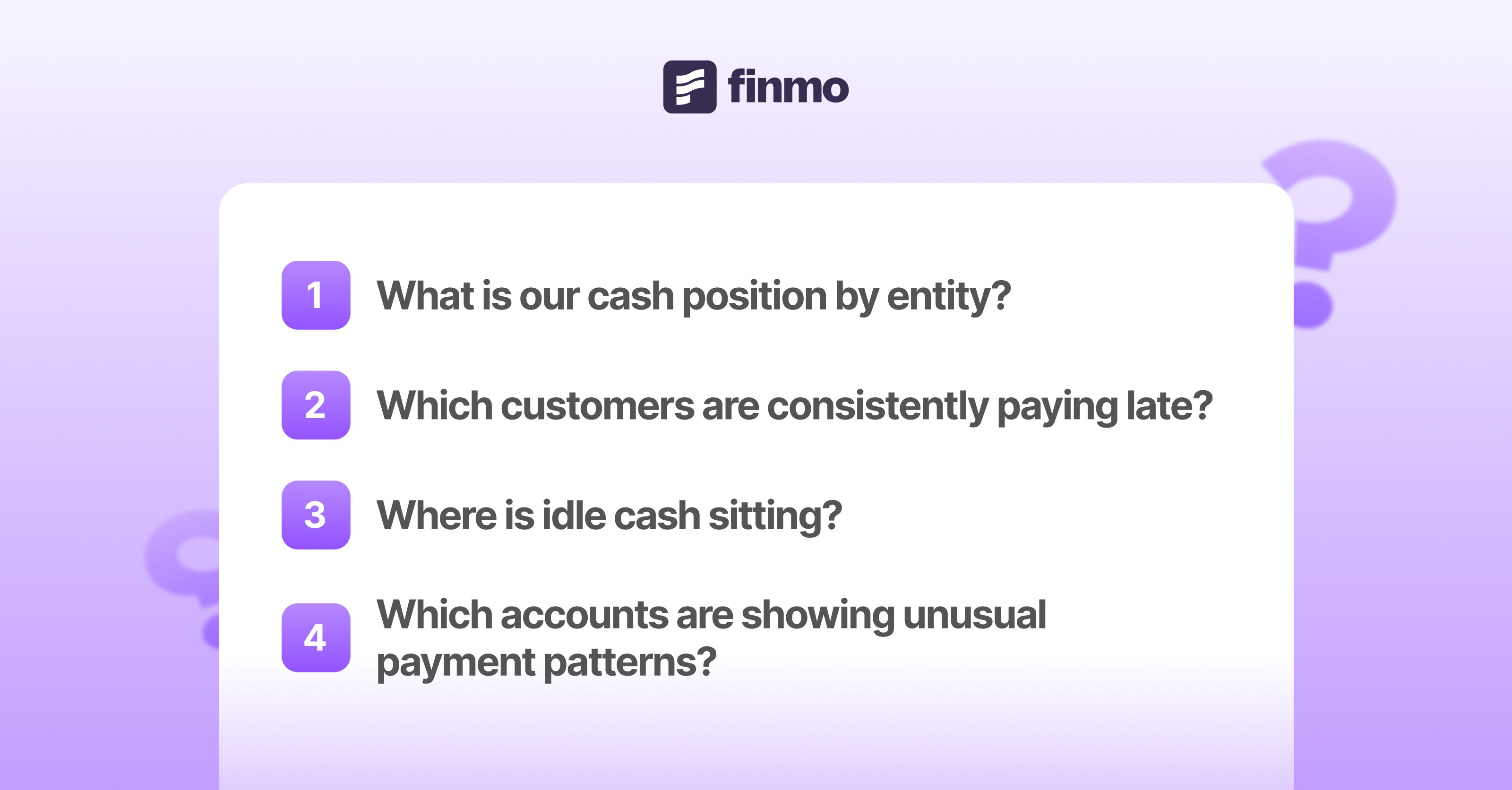
Finmo’s MO AI is designed to help finance leaders interact with their financial data more naturally. Instead of building reports manually or waiting for analysis, users can ask questions such as:
- What is our cash position by entity?
- Which customers are consistently paying late?
- Where is idle cash sitting?
- Which accounts are showing unusual payment patterns?
MO AI also auto-categorises transactions, analyses payment behaviour, identifies cash flow anomalies, and surfaces insights that would otherwise require manual analysis. Instead of being bolted as a separate tool, MO AI is embedded into the same operating layer you use for cash visibility, payments, FX, approvals, and reconciliation.
8. Put idle cash to work
Through regulated partners Syfe and Endowus, Finmo gives you access to yield options for idle cash while keeping liquidity accessible.
What Finmo does not do
Finmo is not designed to replace every function of a full enterprise TMS. Finmo does not currently focus on hedge accounting, derivative management, in-house banking, complex debt portfolio management, SWIFT-heavy treasury infrastructure, or full-scale treasury centre operations. If those capabilities are central to your treasury function, a full enterprise TMS is the better fit.
Finmo is built for a different need: helping growing companies gain control over cash visibility, payments, FX, approvals, reconciliation, and forecasting before they reach enterprise treasury complexity.
What enterprise TMS platforms are built for
Enterprise TMS platforms are designed for organisations with more complex treasury needs. They typically support:
- Cash and liquidity management
- Bank connectivity
- Debt and investment management
- Derivative management
- Hedge accounting
- In-house banking
- Intercompany netting
- SWIFT connectivity
- Treasury policy compliance
- Multi-entity and multi-jurisdictional workflows
If you have a dedicated treasury team managing complex financial structures, these capabilities matter and a full enterprise TMS is the right fit. The question is whether that's the problem you need to solve today.
Where enterprise TMS platforms may be more than growing companies need
If you're at a startup, scale-up, or mid-market company, you're probably not managing derivatives, debt portfolios, hedge accounting, or in-house banking structures yet. Your challenges are operational:
- Cash is spread across banks and currencies
- Payment execution is fragmented
- FX decisions are reactive
- Approvals are manual
- Reconciliation is time-consuming
- Forecasting depends on outdated spreadsheets
- Finance teams lack real-time visibility
For your stage, a full enterprise TMS brings more scope, cost, and implementation effort than you need. Most platforms take 6-18 months to implement, require IT and consulting support to maintain, and bundle modules you won't use for years.
Finmo is designed for growing global companies that need a treasury platform built around the problems they actually have today: live in minutes, not months, with no specialist team required.
Finmo vs enterprise TMS: the practical differences
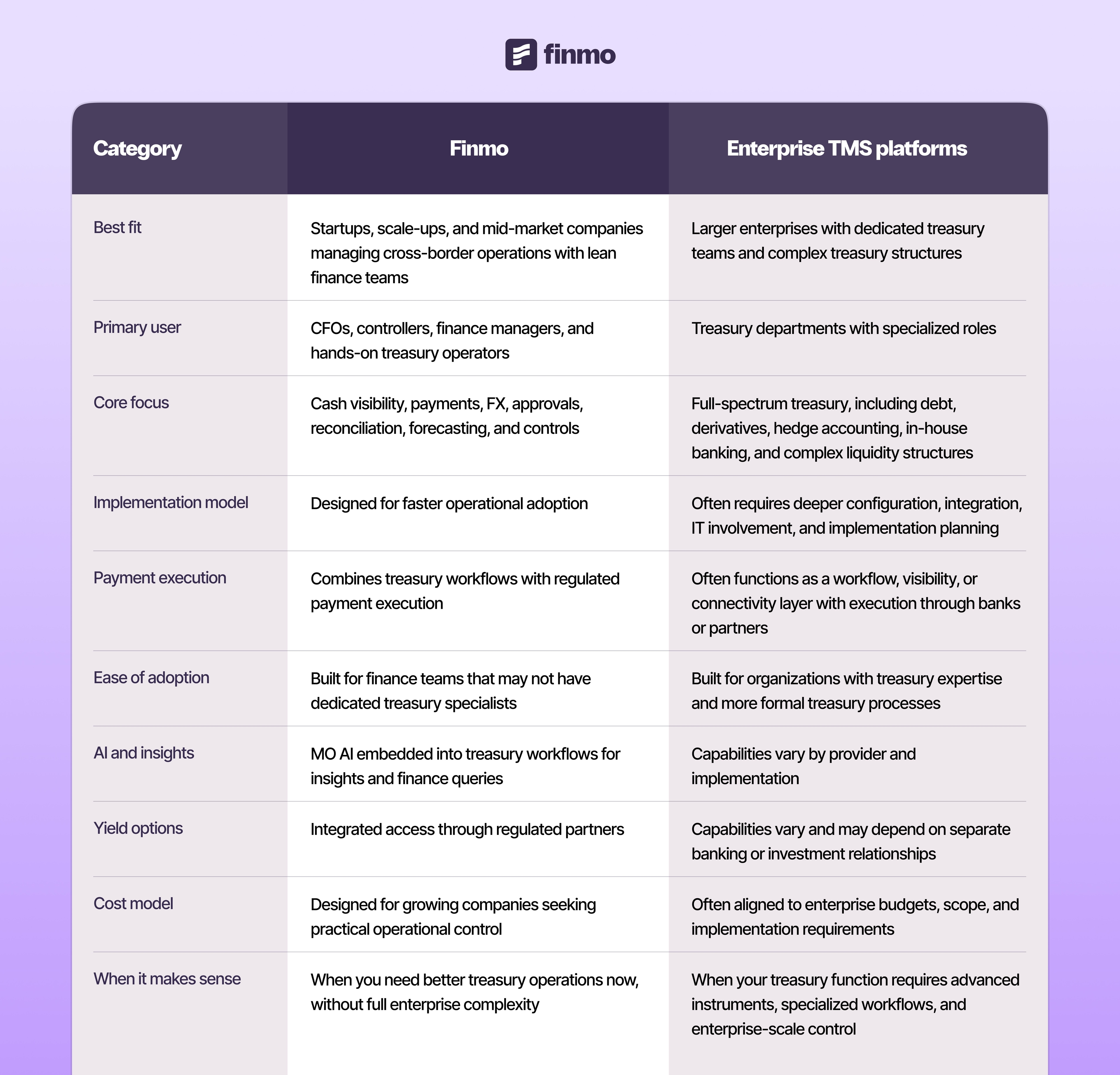
Which treasury operating model fits your stage?
| Question | Finmo (TOS) | Enterprise TMS |
|---|---|---|
| Who owns the treasury today? | ☐ CFO, controller, or finance manager handles treasury alongside other responsibilities | ☐ Dedicated treasury team with specialised roles |
| How does your finance workflow run? | ☐ Visibility, decisions, payments, and reconciliation are fragmented across bank portals, spreadsheets, and disconnected tools | ☐ Treasury is already centralised with structured workflows across complex systems |
| How many bank accounts and entities do you manage? | ☐ Multiple accounts across a few entities; need a consolidated view | ☐ Hundreds of accounts across complex legal structures and treasury centres |
| How do you execute payments? | ☐ Bank portals, manual processes, or separate tools; need embedded execution | ☐ Integrated banking infrastructure with treasury-managed execution |
| What kind of FX exposure do you manage? | ☐ Operational FX tied to vendor payments, payroll, collections, transfers | ☐ Structured FX programs involving derivatives, hedge accounting, or formal risk strategies |
| What level of controls do you need? | ☐ Approval workflows, spending limits, role-based access | ☐ In-house banking, intercompany netting, complex treasury policy controls |
| How fast do you need to be operational? | ☐ Need treasury visibility and controls working quickly | ☐ Can support a longer implementation involving consultants, IT, and bank connectivity |
| What financial instruments do you manage? | ☐ Cash, receivables, payables, operational FX, payments | ☐ Debt portfolios, derivatives, investment programs, hedge accounting |
| What do you want to do with idle cash? | ☐ Put surplus balances to work through integrated yield options | ☐ Manage through separate banking or investment relationships |
| How do you want to access insights? | ☐ Embedded insights and AI-assisted answers within the treasury workflow | ☐ Analyst-driven reporting, BI infrastructure, formal treasury reporting processes |
How to read this:
- Mostly left column → Finmo's TOS approach is built for your stage.
- Mostly right column → You are operating at enterprise treasury complexity. A full enterprise TMS is likely the better fit.
Finmo is built for globally scaling companies
Treasury complexity arrives earlier than most finance teams expect. You may not have a dedicated treasury team yet, but you still need to know where your cash sits, move money across borders, manage currency exposure, approve payments with proper controls, reconcile without manual strain, and forecast with confidence, and you can't do any of it well from bank portals and spreadsheets.
If you're managing cash across multiple banks, paying in multiple currencies, and running finance operations without dedicated treasury support, that's the signal. You've outgrown fragmented tools, and you're not ready for the scope of a full enterprise TMS. Finmo is the layer in between which is built to give you operational treasury control at the stage you're actually at.
Explore Finmo's Treasury Operating System
FAQ
What is Finmo?
Finmo is a Treasury Operating System (TOS) for growing companies. It helps finance teams manage cash visibility, global payments, FX, approval workflows, reconciliation, forecasting, and controls from one connected platform. It is designed for companies that need better treasury operations but don't yet require a full enterprise treasury management system.
What Finmo does not do?
Finmo doesn't cover hedge accounting, derivative management, in-house banking, or SWIFT connectivity. If your operations require these capabilities, you need a full TMS platform.
Is Finmo a TMS-Lite platform?
Finmo is more accurately described as a Treasury Operating System. The "TMS-Lite" label can imply a smaller version of an enterprise TMS, but Finmo is built for the practical treasury needs of growing companies: cash visibility, payments, FX, approvals, reconciliation, forecasting, and controls.
How is Finmo different from enterprise TMS platforms?
Enterprise TMS platforms are designed for organisations with dedicated treasury teams and complex requirements like debt management, derivatives, hedge accounting, in-house banking, and SWIFT connectivity. Finmo is designed for companies that need operational treasury control without the enterprise complexity.
Does Finmo replace my ERP or accounting software?
No. Finmo sits alongside your ERP and accounting tools. Your ERP or accounting system remains the system of record for financial reporting and accounting workflows.
Who is Finmo best suited for?
Finmo is best suited for startups, scale-ups, and mid-market companies that operate across multiple markets, manage multiple currencies and bank accounts, need better cash visibility, execute global payments, want stronger approval controls, rely on lean finance teams, and are not yet ready for full enterprise treasury infrastructure.
When should a company consider a full enterprise TMS instead?
A company should consider a full enterprise TMS when it has dedicated treasury specialists and requires capabilities like hedge accounting, derivative management, debt portfolio management, in-house banking, intercompany netting, complex liquidity structures, or treasury centre operations. At that stage, the company's needs go beyond Finmo's core operating model.