TMS vs TMS-lite: What startups actually need
- Why startups are rethinking treasury infrastructure
- What is a TMS and TMS-lite?
- TMS vs TMS-Lite: Key differences
- Finmo: TMS-Lite platform with embedded payments built in
- Finmo vs Kyriba: The TMS-lite vs TMS showdown
- Self-diagnostic checklist: Do you need a TMS or TMS-Lite?
- TMS or TMS-Lite: Making the right call for your stage
- Link copied
Most Series A and B CFOs already know they've outgrown spreadsheets. The natural next step is to look at treasury management systems.
But most TMS platforms on the market were designed for enterprises with dedicated treasury teams, months to spend on implementation, and budgets to match all of it. Adopting an enterprise TMS at the wrong stage can do more harm than good for your treasury function. It can create operational friction and complexity that your finance team isn't equipped to absorb.
There’s a newer category of treasury tools that is specifically designed for this gap: TMS-lite platforms with embedded payments
TMS-lite platforms offer all the core capabilities growing startups actually need including real-time cash visibility, cashflow forecasting, and global payment execution–but without the complexity of a full enterprise system.
This guide breaks down the difference between TMS and TMS-Lite, and helps Series A and B finance leaders assess which level of infrastructure is right for their stage.
Key takeaways
- Enterprise TMS platforms are built for large corporations with dedicated treasury teams, not lean startup finance functions.
- TMS-Lite platforms provide the core capabilities most Series A/B startups need: real-time cash visibility, cashflow forecasting, and global payment execution.
- Adopting a full TMS too early creates operational friction, long implementation cycles, and complexity your team isn't ready to manage.
- Finmo is a TMS-Lite platform with embedded payments built in, giving Series A and B finance teams structured treasury control without enterprise overhead.
Why startups are rethinking treasury infrastructure
For most startups, the first sign of a treasury problem occurs when small inefficiencies compound until they become impossible to ignore.
Spreadsheets stop being reliable
Spreadsheets work only when your startup’s treasury management process is rather simple. But once a startup starts operating across multiple banks, currencies, and countries the 2D column-row model breaks down. Your data will be outdated every time you want to make real-time decisions and version control for spreadsheet files will become a problem nobody has time to solve.
Payments become disconnected from treasury
As cross-border operations grow, payments and treasury visibility end up in separate places. Finance teams check liquidity in one platform and execute payments through bank portals in another. Then there are approvals that happen over email and reconciliation that can only be done manually at month-end. Each step is manageable in isolation, but together they create a control and visibility gap that grows as your startup grows in size.
Finance is expected to be more strategic
When startups reach Series A/B stage, the role of CFOs also shifts. Boards no longer just want accurate books. They want a finance leader who can model the next 12 months, stress-test hiring plans, and make a clear case for where capital should go next.
That means runway forecasting needs to be defensible and expansion decisions need to be backed by real liquidity data, not a spreadsheet that was last updated before the weekend.
Most treasury tools weren't built for this. They were built to record what happened, not to help finance leaders plan what comes next.
What is a TMS and TMS-lite?
A Treasury Management System (TMS) is enterprise-grade software built to manage complex treasury operations across large organisations, such as cash management across dozens of entities, risk management including hedge accounting and derivatives, and compliance workflows across multiple jurisdictions.
Implementation can take six to eighteen months, require internal IT resources and external consultants, and carry high licensing and maintenance costs. For late-stage scaleups and multinationals with genuine treasury complexity, that investment is justified.
For a Series A startup with a lean finance team, enterprise TMS introduces far more overhead than the business can absorb.
TMS-Lite covers the workflows that actually matter to startups at this stage such as real-time cash visibility, dynamic forecasting from live data, global payments with approval controls, and practical FX management for cross-border operations.
Embedded payments are built directly into the platform so your team doesn’t need to switch to a separate bank portal every time your dashboard tells you to act.TMS-Lite doesn't try to replace a corporate treasury department. It gives lean finance teams the clarity and control they need to operate as the business scales, without requiring a treasury specialist to run it.
TMS-Lite is not a smaller TMS. It is a new category built for fast growing companies that are scaling and expanding into different markets and dealing with multiple currencies, without enterprise overhead.
TMS vs TMS-Lite: Key differences
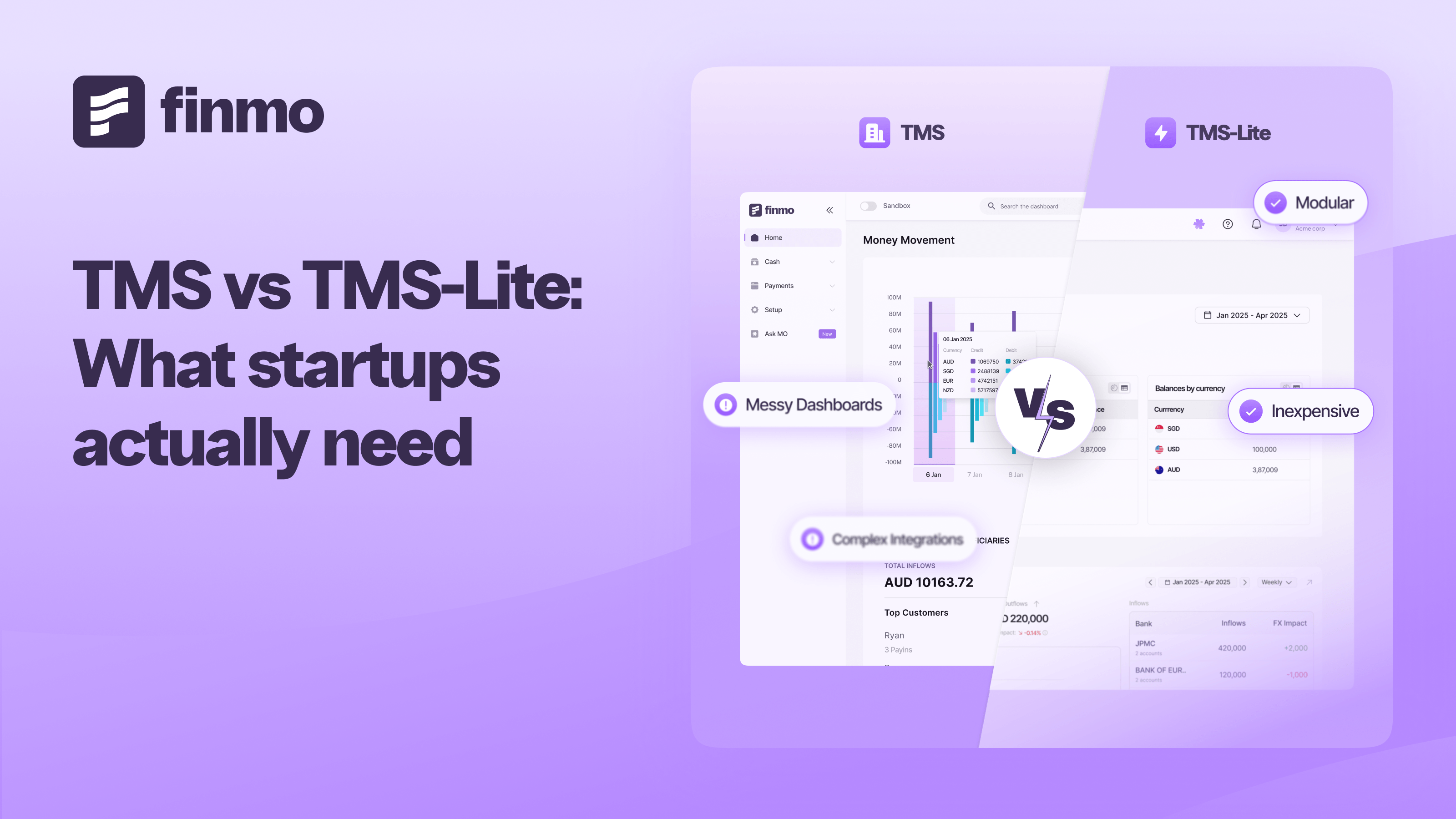
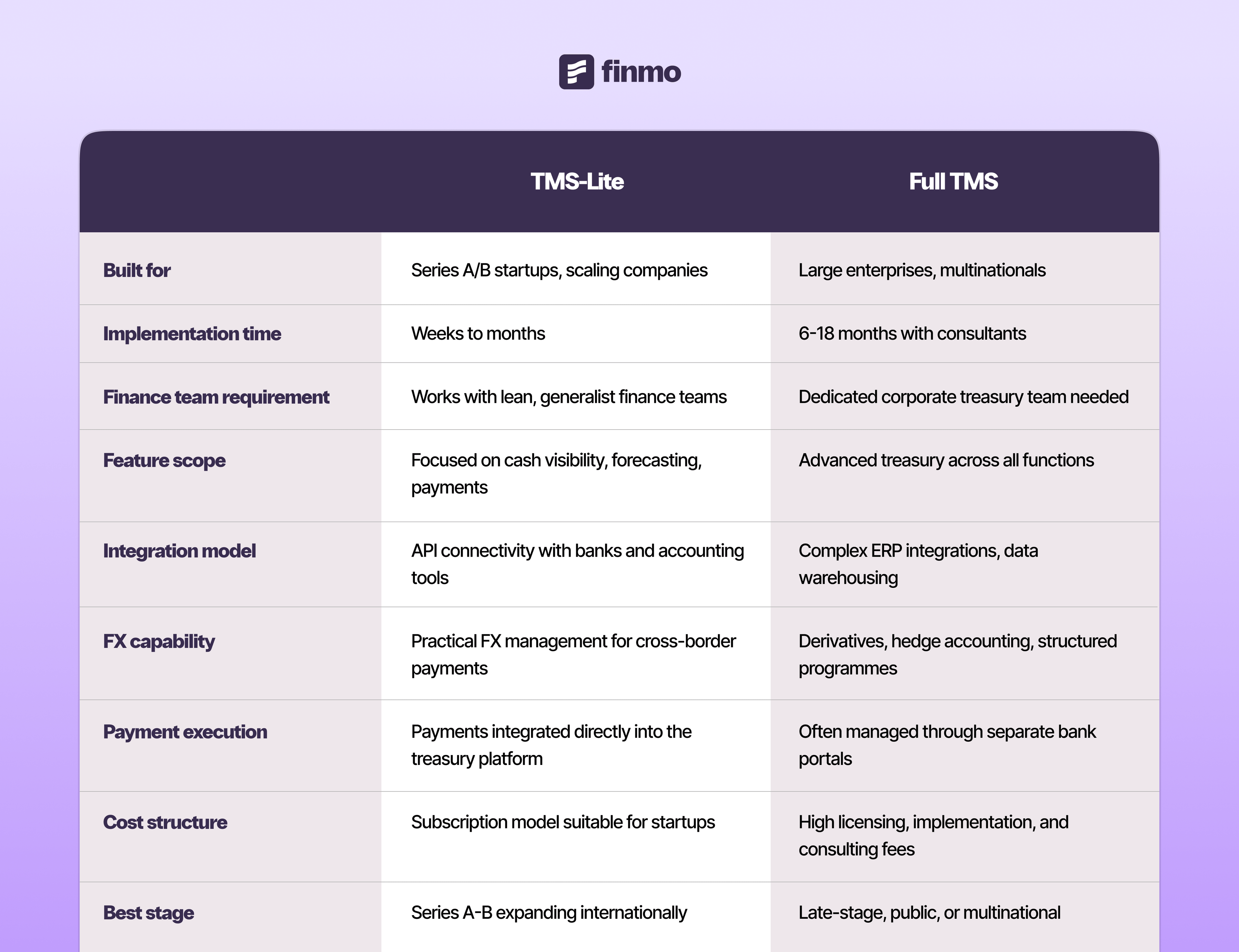
The key differences between TMS and TMS-lite come down to who they're built for, how fast they can be deployed, and what they expect from your finance team.
Finmo: TMS-Lite platform with embedded payments built in
Finmo is a TMS-lite platform built for Series A and B startups. It provides the core treasury infrastructure growing companies need including cash visibility, forecasting, and payment execution, without the complexity of enterprise systems or the limitations of spreadsheet-based workflows.
Here's how Finmo works in practice:
- Real-time global cash visibility: Finmo connects directly to banks, ERPs, and accounting systems via APIs to consolidate balances across currencies, entities, and accounts into a single real-time dashboard. It has integrations with 2000+ bank accounts globally. CFOs get a continuously updated view of total liquidity and answer board questions about runway, headcount decisions, and liquidity gaps from one source of truth.
- Dynamic cashflow forecasting: Finmo's forecasting engine builds liquidity projections from live financial data. It's also possible to analyze ‘what-if’ situations with scenario modelling.
- Embedded payments and FX management: In most finance stacks, insight and execution are disconnected. You see the problem in one system and fix it in another. TMS-lite platforms like Finmo collapse that gap. Finance teams can initiate cross-border payments, hold multi-currency balances in virtual local accounts, lock FX rates before funds go out, and route approvals through structured workflows–all without leaving the system.
Finmo vs Kyriba: The TMS-lite vs TMS showdown
The TMS market isn't short of options, but while most platforms are enterprise TMSes, only a few support lean startup finance functions.
Kyriba is a cloud-based TMS designed for enterprise organizations with dedicated treasury teams and the internal resources to configure and run a system of that complexity. Pricing is subscription-based but customised by module, user count, and connectivity requirements, which means costs scale quickly as configuration needs grow.
For a Series A or B startup with a lean finance team, that configuration overhead is the problem. You're not trying to run a multi-module enterprise treasury platform. You're trying to see your cash clearly, forecast accurately, and move money across borders without switching between systems.
Finmo is built specifically for startups in Series A or B stage. As a TMS-Lite platform, it connects directly to your banks, ERPs, and accounting systems via API to give you a real-time view of cash across all entities and currencies. Implementation takes minutes, not months.The result is a single connected workflow where you get visibility, forecasting, and execution all in one platform.
Self-diagnostic checklist: Do you need a TMS or TMS-Lite?
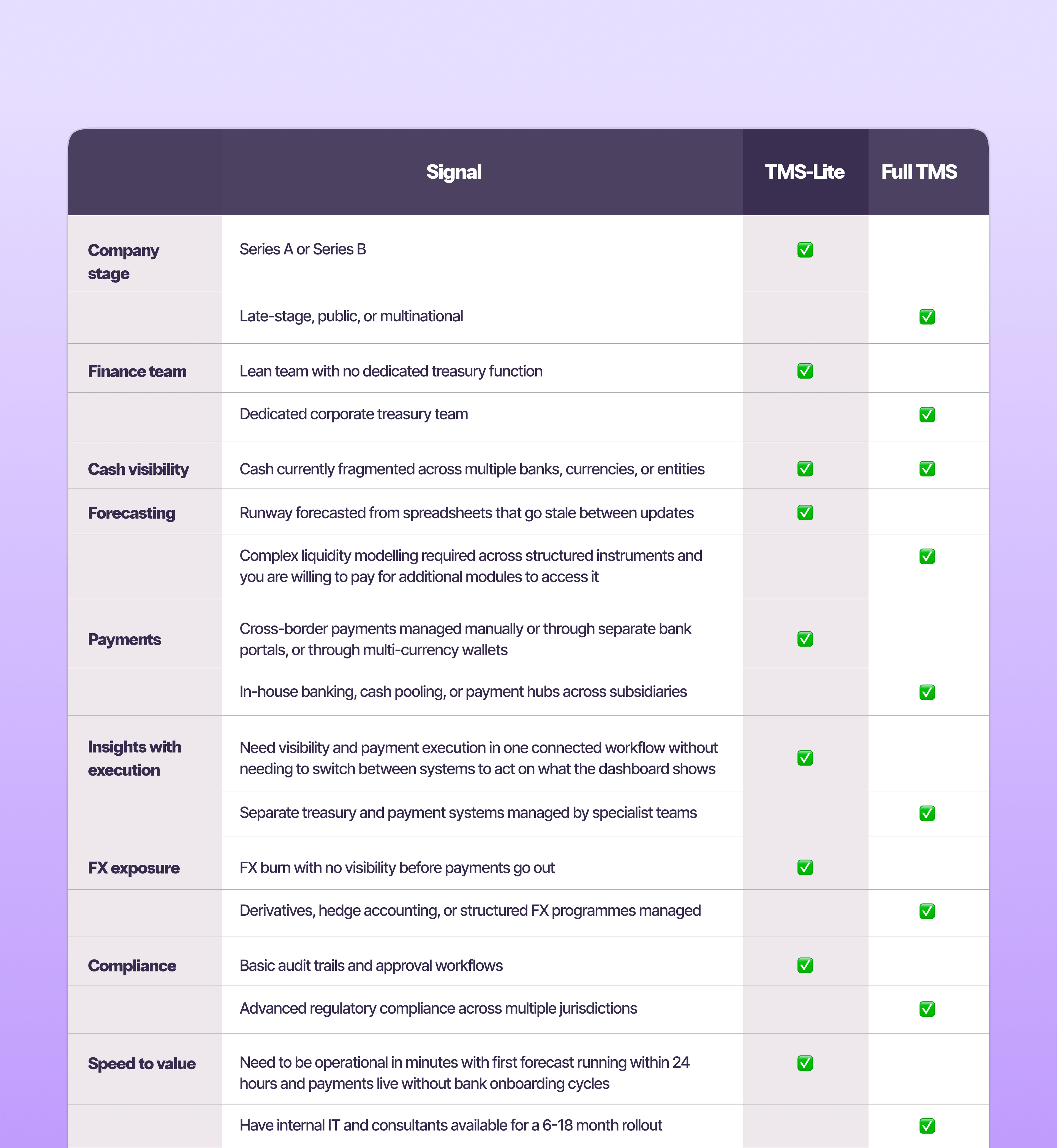
Before choosing treasury infrastructure, assess where your company actually stands.
How to read your results:
- Mostly TMS-Lite: You need real-time visibility and structured execution, not enterprise infrastructure. Start here and build up as complexity grows.
- Mostly Full TMS: Your treasury operations have outgrown what a TMS-Lite platform is designed to handle. An enterprise TMS with a dedicated team is the right next step.
- Roughly split: You're likely approaching the transition point but not there yet. TMS-Lite can give your treasury the foundation it needs. You should move to a full TMS when you have the team and complexity to justify it.
TMS or TMS-Lite: Making the right call for your stage
Both TMS and TMS-Lite solve real problems, just for different stages. TMS-Lite is designed for the stage where most Series A and B startups are building visibility, structuring execution, and scaling their finance function.
Use the checklist and comparison table above to assess where you actually stand. If you're closer to the TMS-Lite column, Finmo can get you operational in weeks and streamline your finance operations.
Connect your accounts and start managing treasury with real-time visibility in minutes.
FAQs
What is the difference between TMS and TMS-Lite?
A full Treasury Management System is an enterprise-grade platform designed for large organisations with dedicated treasury teams. TMS-Lite is a simplified version focused on the core treasury workflows startups actually need such cash visibility, cashflow forecasting, and global payment execution.
Do startups need a Treasury Management System?
Regardless of size or stage, every company benefits from knowing its real cash position and true runway. That visibility becomes operationally critical as companies expand across borders. Once you're managing more than three or four currency pairs, paying vendors and teams in multiple markets, and operating across entities, manual tools stop giving you an accurate picture of where your cash actually stands.
At that point, treasury management stops being an administrative function and becomes a strategic one. A TMS-Lite platform gives growing startups the cash visibility and forecasting accuracy they need to make confident decisions, without requiring a dedicated treasury team to run it.
What is embedded payments in treasury?
Embedded payments means payment execution is built directly into the treasury platform rather than handled through separate bank portals. When payments are embedded, finance teams can initiate, approve, and track cross-border payments within the same system they use for cash visibility and forecasting. With Finmo's multi-currency accounts, businesses can collect in 30+ currencies and pay to 180+ countries–all without leaving the treasury platform.
When should you choose TMS-Lite over TMS?
TMS-Lite is the right choice when your startup is at Series A or Series B, your finance team is lean, and you need real treasury capability without six months of implementation overhead. A full TMS becomes relevant when you have a dedicated treasury team and genuinely complex requirements like structured debt management, derivatives, or regulatory compliance across multiple jurisdictions.