The Hedge That “Lost Money” and Still Did Its Job


- Link copied
Part 4 of From Exposure to Execution: Practical FX Risk Management
A hedging policy is approved once. It has to be applied every month after that.
That is where a policy gets tested.
A payment date moves. A purchase order is canceled. A bank quotes a forward rate nobody expected. A forecast comes in light for the fourth quarter in a row.
None of these means the policy was badly written. They are the ordinary friction of applying it to a business that does not stand still.
The first three pieces in this series dealt largely with building the framework: deriving hedge ratios from measured forecast accuracy rather than benchmarks; testing whether those ratios can actually be executed given credit, pricing and liquidity constraints; and putting those decisions into a policy with the assumptions recorded.
This one starts after the policy is signed.
The hedge that appears to lose money
Consider an importer that needs €1.0 million for inventory.
The budget rate is EUR/USD 1.10. Policy coverage for this exposure class and tenor is 70%, so the company contracts €700,000 forward at 1.105 and leaves €300,000 open.
At settlement, spot is 1.04. The euro has weakened.
Someone runs the obvious comparison:
The forward was struck at 1.105. Spot is now 1.04. On €700,000, the difference is about US$45,500.
Viewed on its own, the derivative lost money.
But the derivative was never meant to be viewed on its own.
Here is what the company actually paid:
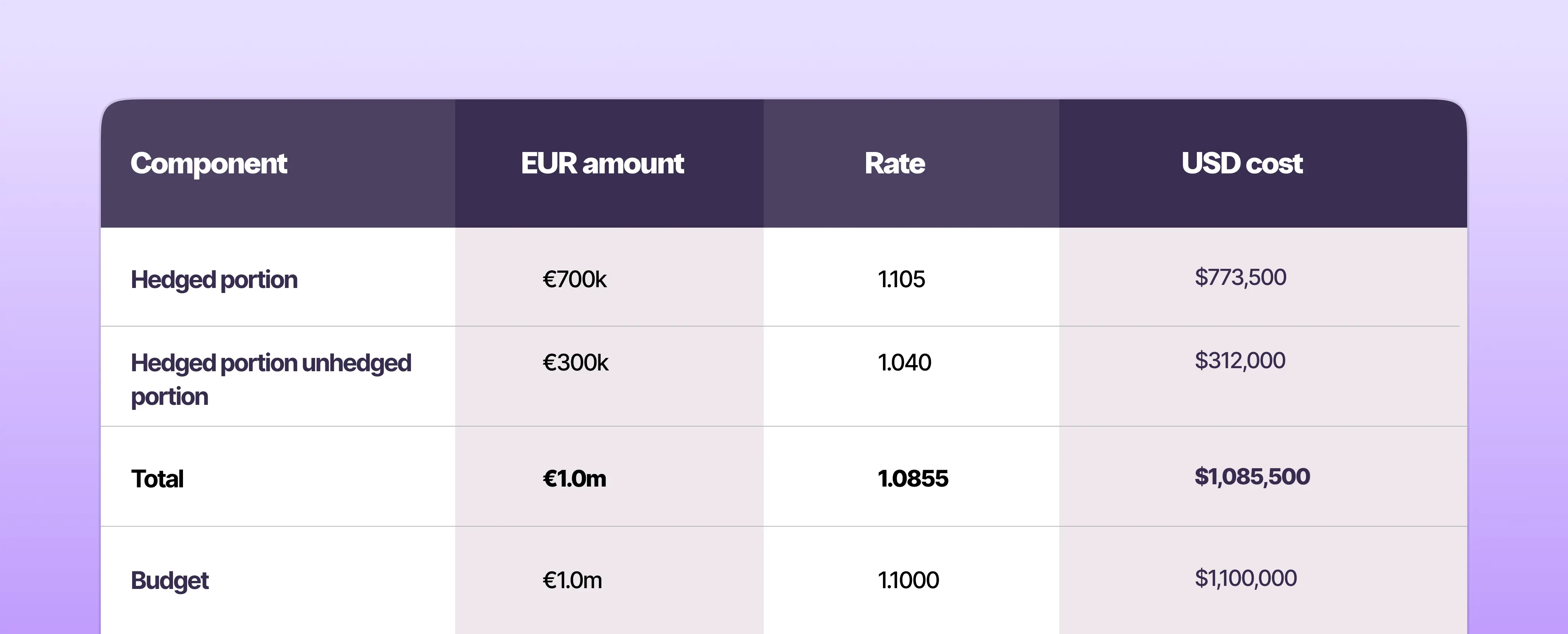
The company spent US$1,085,500 against a budget of US$1,100,000.
Its effective realized rate was 1.0855 against a planning rate of 1.10.
If the objective of the hedge was to reduce uncertainty around the budgeted cost of inventory, settlement-day spot is the wrong scorecard.
The same test has to work when the currency moves the other way
The argument is more useful if it survives the opposite outcome.
Suppose the euro strengthens to 1.16 instead.
The €700,000 hedge still settles at 1.105. The remaining €300,000 is purchased at 1.16.
Total cost becomes US$1,121,500, an effective rate of 1.1215.
That is US$21,500 above budget.
But without the hedge, the purchase would have cost US$1,160,000 — US$60,000 above budget.
So in one scenario the company finishes below budget, and in the other it finishes above it. In both, the hedge materially reduces the distance between the actual outcome and the planning rate.
That is the point.
The program was not designed to produce the best available FX rate. It was designed to narrow the range of possible outcomes around a rate the business had used for pricing, margin or cash-flow planning.
A standalone derivative loss is therefore not, by itself, evidence of poor hedging.
Sometimes it is exactly what you should expect when the underlying exposure has moved favorably in the other direction.
What to report instead
If settlement-day spot is not the benchmark, something else has to replace it.
For an SME finance team, the useful measures are relatively narrow:
- Effective realized rate against the applicable policy reference, by currency and exposure class
- Coverage achieved against target, minimum and maximum
- Forecast accuracy and timing error
- Forward points and option premiums, shown separately
- Roll and close-out costs
- Counterparty credit and collateral utilization
- Peak settlement-liquidity requirement
- Exceptions and breaches
The questions behind those measures are just as important.
Was there a valid underlying exposure when the hedge was entered?
Was the coverage within policy?
Was it consistent with the forecast's reliability?
Was the all-in rate independently checked?
Were the dealing controls followed?
Did the hedge reduce the variance the policy was designed to manage?
And when the result differed from plan, was the cause the currency move, forecast error, settlement timing, pricing, roll cost or an actual policy breach?
None of that necessarily requires a treasury management system.
It does require deciding in advance what the program is intended to accomplish and measuring against that objective.
Five other situations the policy has to survive
The scorecard problem is only one example. The same issue appears elsewhere: what seems intuitive in the moment may not be what the policy was designed to do.
The importer separating what is known from what is forecast.
A recognized payable and a forecast purchase have different certainty characteristics. The first is already an obligation. The second can still change in amount, timing or existence. That difference should inform coverage rather than applying one ratio simply because both exposures are in the same currency.
The exporter whose forecasts run optimistic.
If forecast revenue is consistently overstated, that is bias. It should first be addressed in the forecasting process. The remaining variation around the corrected forecast is the uncertainty the hedge program is trying to manage. Otherwise, hedging begins compensating for a forecasting problem.
The natural offset with a timing problem.
Suppose a company expects US$800,000 of customer receipts and US$500,000 of supplier payments. Economically, it is US$300,000 long.
But the supplier has to be paid on the 15th, and the customer cash arrives on the 27th.
For twelve days, the company still has to fund the full US$500,000.
A natural offset reduces FX exposure. It does not necessarily solve the liquidity problem.
The tender that may never become an exposure.
A company bidding for a contract may face significant FX risk if it wins. But if the contract is not awarded, a forward entered for the expected cash flow can remain without a commercial offset.
The degree of certainty in the underlying exposure should therefore affect both the hedge ratio and the instrument used.
The policy that fits the business but not the facility.
A US$1.5 million forward does not necessarily consume US$1.5 million of bank credit capacity. Banks typically assess derivative exposure using their own methodology, which may incorporate mark-to-market, potential future exposure, tenor, netting, collateral and other factors.
So the policy has to be tested against actual available capacity across the program, not simply against trade notional.
The routine is the deliverable
What connects these situations is that better drafting alone does not resolve them.
They are resolved by deciding before the situation arrives and creating a routine that surfaces the issue early enough to act.
For a finance team without a dedicated treasury function, that routine can be relatively simple.
At a minimum:
- Refresh recognized and forecast exposures.
- Apply documented natural offsets and identify the residual open position.
- Review forecast accuracy and timing assumptions.
- Apply the policy coverage bands.
- Check counterparty capacity, collateral requirements and all-in pricing.
- Execute within authority limits, confirm independently and update the hedge register.
- Look ahead at upcoming settlements and liquidity requirements.
- Periodically compare archived forecasts with actual outcomes and revise policy parameters only when there is a documented reason.
Monthly may be sufficient for a relatively stable exposure profile. Businesses with larger, faster-moving or more concentrated exposures may need to run parts of the process more frequently or whenever a material exposure changes.
The important point is the cadence.
A hedging policy is often treated as the output of the exercise — something produced, approved and filed.
In practice, it is the input to an operating process.
The document tells the finance team what it has agreed to do.
The routine is what actually manages the risk.
The document is what you approve. The cadence is what you operate.
Companion guide
The six situations above are worked through in full — with figures, decision tables, the policy clause each scenario tests, and a practical operating cadence - in FX Hedging Policy in Practice: Six Worked Scenarios for SME Finance Leaders.
[Download the companion guide]