The CFO's guide to cash intelligence: Visibility, forecasting and payments

- Link copied
If you’re a CFO at a startup expanding globally, your finance setup is already more complex than it should be.
As soon as you start operating across multiple markets, cash stops being simple. It sits across different bank accounts, currencies, and regions, and moves through systems that don’t fully connect. Visibility becomes fragmented, forecasts rely on outdated inputs, and payments don’t always reflect back into your numbers in real time.
The result is a finance function that spends more time tracking and validating data than acting on it.
Cash intelligence can solve this by bringing visibility, forecasting, and payments into one layer. In this guide, we’ll break down what cash intelligence actually means, why traditional finance setups fall short, and how CFOs can build a connected system that supports both operational control and strategic decision-making.
Why cash intelligence matters for modern CFOs
Today’s CFOs are expected to operate at two speeds at once:
- They handle day-to-day cash operations where they manage liquidity and oversee payments to keep the business running smoothly.
- They drive strategic outcomes, guiding expansion, allocating capital, and building investor confidence
In theory, these two responsibilities should support each other with strong operational control enabling better strategic decisions. But for many startups, the opposite happens.
Most CFOs still operate without real-time cash visibility, which means they spend more time tracking liquidity, reconciling payments, and validating numbers than actually using them. Forecasts are available but most are built on delayed or incomplete data which makes them unreliable.
Industry data highlights the scale of the problem:
- 37% of CFOs do not completely trust the accuracy of their financial data, and 98% lack complete confidence in their cash flow visibility.
- 50% of finance executives say poor cash visibility slows their ability to respond to market fluctuations.
So while CFOs are expected to act as strategic leaders for the startup, they remain tied to operational inefficiencies that should not exist at this stage. And the primary cause of this problem is the lack of connection between finance data.
Most finance teams today operate across three disconnected layers:
- Cash visibility: Viewing balances across bank portals or dashboards
- Cash flow forecasting: Managing projections in spreadsheets or planning tools
- Payments: Executing transactions through banks or PSPs
Data sits across multiple bank accounts, ERPs, spreadsheets, and analytical tools, with no single source of truth. This makes reconciliation time-consuming and, more importantly, makes a real-time view of cash almost impossible.
Cash intelligence fills this gap by acting as the missing layer that connects visibility, forecasting, and payments into a single system. Instead of operating as separate workflows, these functions begin to work together. It ensures that:
- Visibility reflects real-time cash positions across the business
- Forecasting is built on live data, not outdated assumptions
- Payments feed directly back into both, keeping the system aligned
Cash intelligence vs traditional approaches
Most finance teams still rely on a mix of spreadsheets, bank portals, and legacy treasury systems. While each of them solves a part of the problem, none solve the problem end-to-end.
| Approach | What it offers | Where it falls short |
|---|---|---|
| Spreadsheets | Flexible modelling and forecasting | Manual updates, error-prone, quickly outdated |
| Bank portals | Access to account-level balances and transactions | Fragmented view, no consolidated view |
| Traditional treasury systems | Advanced treasury capabilities and controls | Complex, expensive, slow to implement, and not suitable for scaling startups |
| Cash intelligence | Real-time, connected, continuously updated system | – |
The hidden cost of operating without cash intelligence
The breakdown in finance systems rarely ever appears as a sudden disruption. There is no single moment where something clearly stops working or demands immediate attention.
Here are all the hidden costs that businesses have to bear when operating without cash intelligence
- You start building buffers instead of making confident decisions
When visibility is delayed and forecasts are consistently unreliable, the first impact shows up in how CFOs manage liquidity.
They begin to compensate for the lack of clarity by increasing liquidity buffers. Capital gets held back, and decisions that depend on available liquidity are delayed or scaled down.
2. You spend more time validating information than acting on it
When basic questions about cash require pulling data from multiple systems, finance teams get pulled into a cycle of constant manual reconciliation.
This creates a workflow where:
- Reports are available, but require validation before use
- Forecasts are prepared, but need adjustments to reflect recent changes
- Numbers exist, but are not immediately actionable
Instead of focusing on capital allocation, risk management, or growth planning, a significant portion of time is spent aligning data, resolving discrepancies, and confirming accuracy.
3.You respond to issues after they surface instead of anticipating them
The most significant impact of disconnected systems is the loss of forward visibility.
- Liquidity constraints become visible only when cash positions tighten.
- FX impacts are recognized after they have already affected margins.
- Working capital inefficiencies come up when they begin to disrupt operations.
And in fast-moving environments, that delay translates into missed opportunities and slower execution. Cash intelligence helps shift finance from reactive to proactive.
Is your business missing the cash intelligence layer?
Use this quick checklist to assess whether your finance function is operating with connected cash intelligence, or still relying on fragmented workflows.
How to interpret this:
Mostly “No” → Fragmented cash systems
Mostly “Sometimes” → Partial visibility
Mostly “Yes” → Connected cash intelligence
| Area | Question | Yes / Sometimes / No |
|---|---|---|
| Cash visibility | Can you see balances across all bank accounts and entities in one place, in real time? | ☐ |
| Can you confidently answer “how much cash do we have right now?” without manual consolidation? | ☐ | |
| Do you have visibility into where cash is sitting across different currencies and regions? | ☐ | |
| Can you identify idle or trapped cash without digging through multiple systems? | ☐ | |
| Forecasting | Do your forecasts update automatically based on real transactions and cash movements? | ☐ |
| Can you see expected inflows and outflows in a structured, near-term view (e.g., weekly)? | ☐ | |
| Do you trust your forecasts enough to make hiring, expansion, or investment decisions? | ☐ | |
| Can you quickly run scenarios (delayed payments, FX changes, cost spikes) and see the impact? | ☐ | |
| Payments | Are payments tracked in the same system where you view cash and forecasts? | ☐ |
| Do payment approvals follow a structured workflow instead of email or chat? | ☐ | |
| Do completed payments instantly update your cash position and forecasts? | ☐ | |
| Can you track the full lifecycle of a payment from initiation to settlement? | ☐ | |
| Data & Workflow | Do you avoid switching between multiple tools (bank portals, spreadsheets, ERPs) to get a complete picture? | ☐ |
| Is your financial data consistent across systems without frequent reconciliation? | ☐ | |
| Can your team spend more time analyzing data than validating it? | ☐ | |
| Decision Making | Can you make liquidity or investment decisions without double-checking the data? | ☐ |
| Do you identify risks (cash shortfalls, FX exposure) early rather than after they occur? | ☐ |
What cash intelligence looks like when it actually works
Instead of introducing new workflows, cash intelligence changes how the existing workflows in your finance function interact. Instead of operating in stages where visibility feeds forecasting and forecasting informs execution, finance begins to function as a continuous system where each action updates the next.
Each phase builds toward the same outcome: a finance function where visibility, forecasting, and execution are no longer separate processes, but parts of a single, connected system.
See → Plan → Act
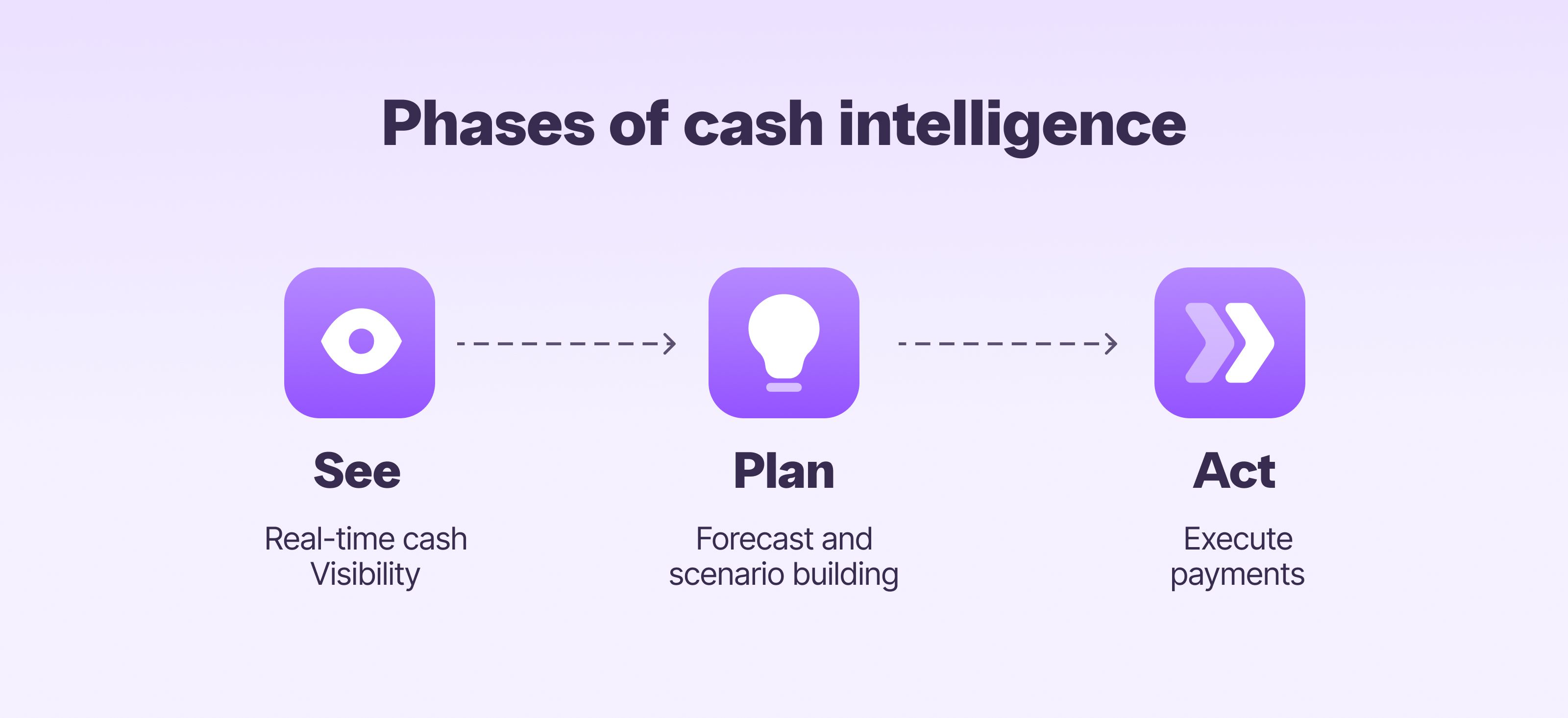
Here’s what cash intelligence looks like when it actually works well
Phase 1: Build a real-time cash visibility foundation
The goal at this stage is to move away from visibility as a reporting outcome and achieve real-time visibility.
This requires connecting all relevant bank accounts and financial systems into a single view, where balances can be accessed instantly without manual intervention. It also involves reducing reliance on spreadsheets for consolidation, which are inherently static and prone to becoming outdated.
Once this foundation is in place, finance teams can answer basic but critical questions with confidence, such as the current cash position across entities and the distribution of liquidity.
Phase 2: Introduce dynamic, data-connected forecasting
Traditional forecasting methods rely heavily on static models that are updated periodically. While these can provide directional insight, they struggle to keep up with the pace of change in startups.
To move toward cash intelligence, forecasting needs to be connected directly to live financial data. This means integrating forecasts with actual transactions, receivables and payables (AR/ AP), and bank accounts across different currencies and countries.
Forecasts are no longer based on static assumptions. They update continuously as new data flows in, staying aligned with actual business activity.
This enables rolling forecasts that update continuously. It also allows for scenario modelling, where CFOs can test the impact of delays, cost changes, or revenue shifts in real time.
Phase 3: Integrate execution through payments and reconciliation
To complete the transition to cash intelligence, payments need to be fully integrated into the workflow, which involves centralizing payment processes so that:
- Transactions are visible at the point of execution
- Approvals are structured and traceable
- Reconciliation is automated rather than manual
When payments are connected in this way, every transaction immediately updates both cash visibility and forecasting. This closes the loop between seeing, planning, and acting.
How Finmo enables cash intelligence
Finmo operates as a TMS-lite platform, bringing together cash visibility, forecasting, and payments into a single connected system. Instead of switching between tools, CFOs can manage how cash is seen, planned, and moved–all through a dedicated dashboard in one place.
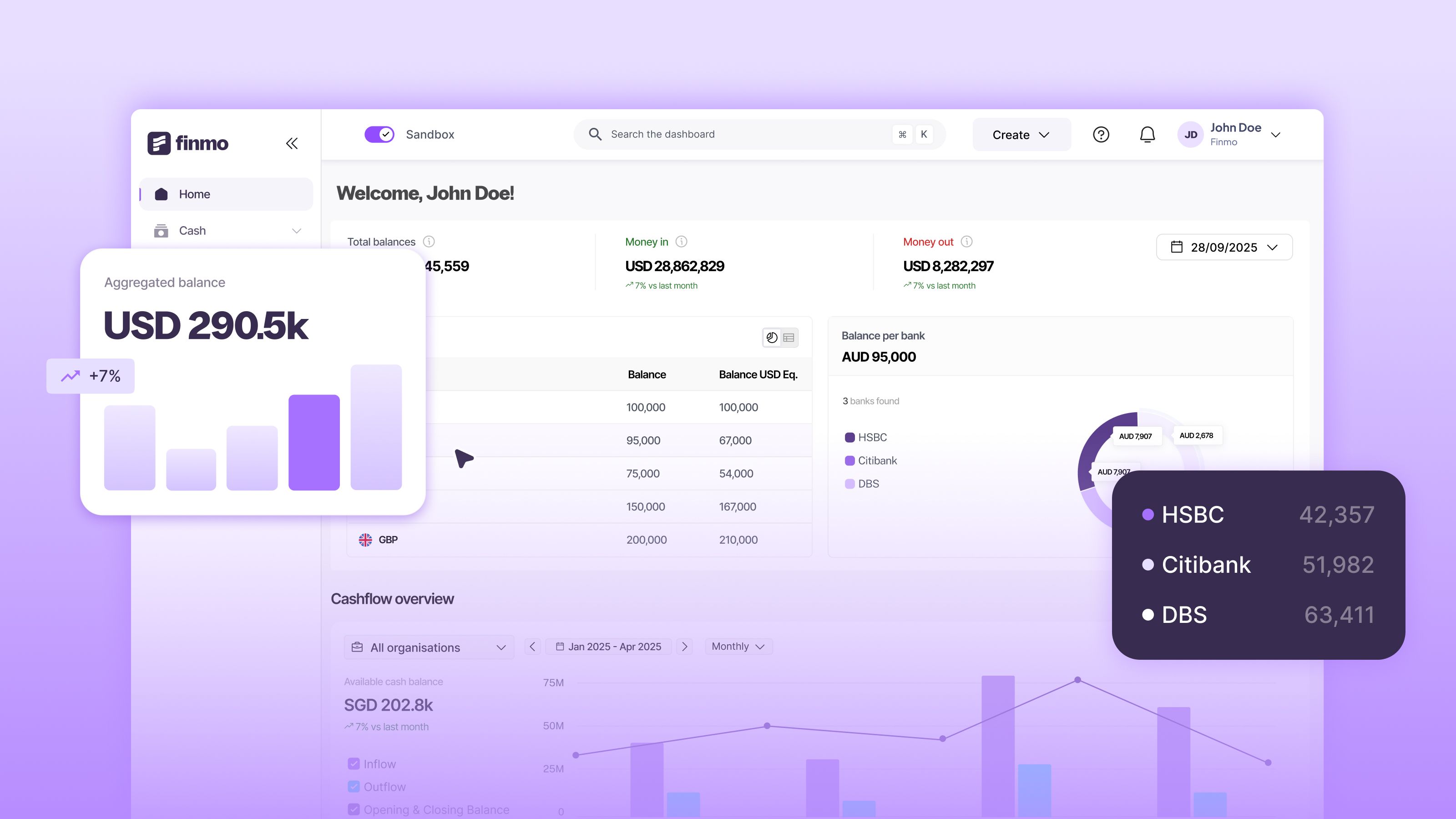
See your global cash position across accounts, entities, and currencies in real time, without switching between systems.
- Track how funds move, with full payment lifecycle visibility from initiation to settlement
- Identify FX exposures that impact margins
- View upcoming receivables and payables to better understand near-term liquidity
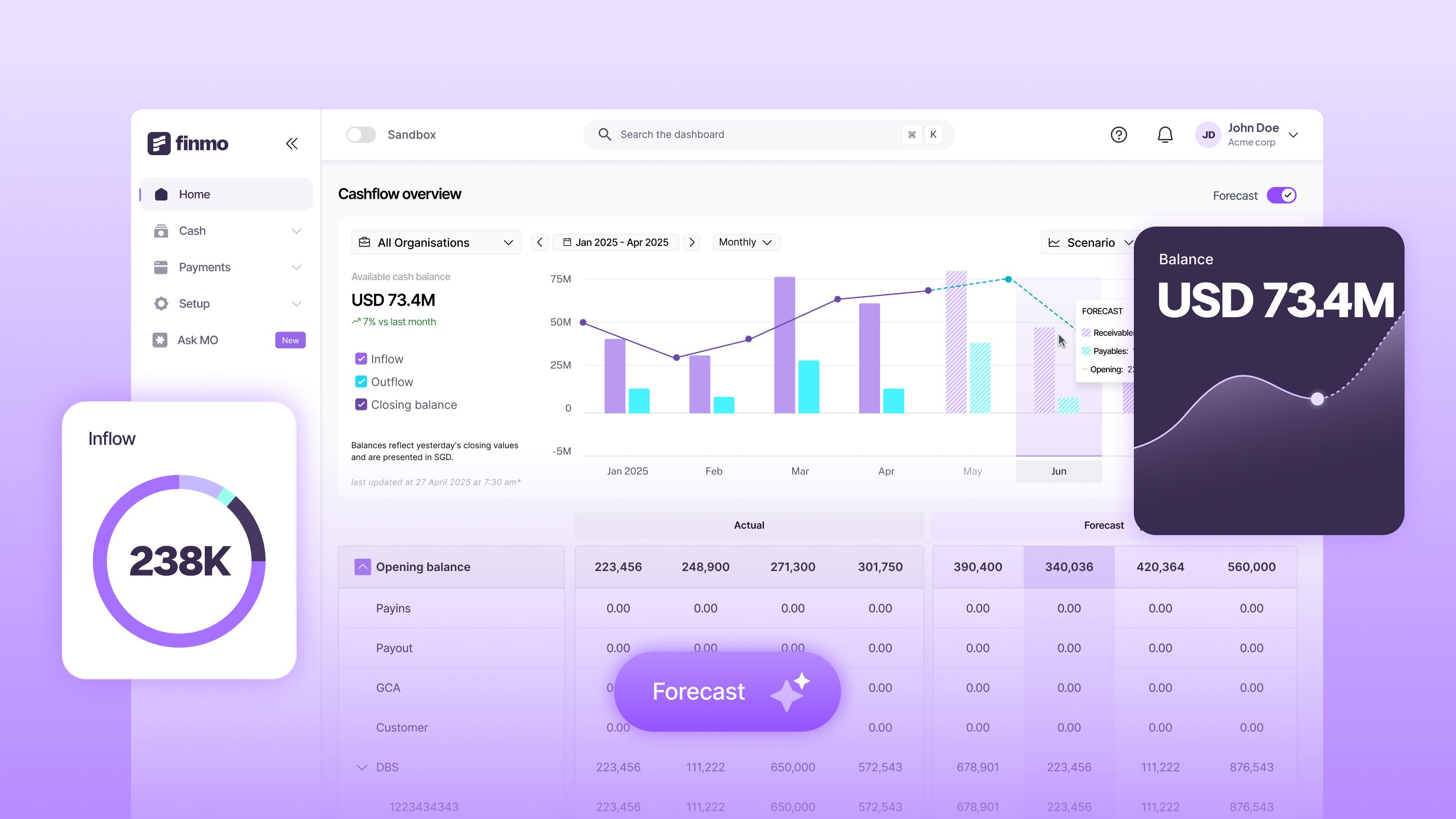
Build dynamic cash flow forecasts that update automatically based on transactions, receivables and payables.
- Run scenario simulations to understand the impact of delays, cost changes, or revenue shifts
- Switch instantly between best-case and worst-case scenarios for comparison
- Visualize projections through charts and tables, and export reports for stakeholder alignment
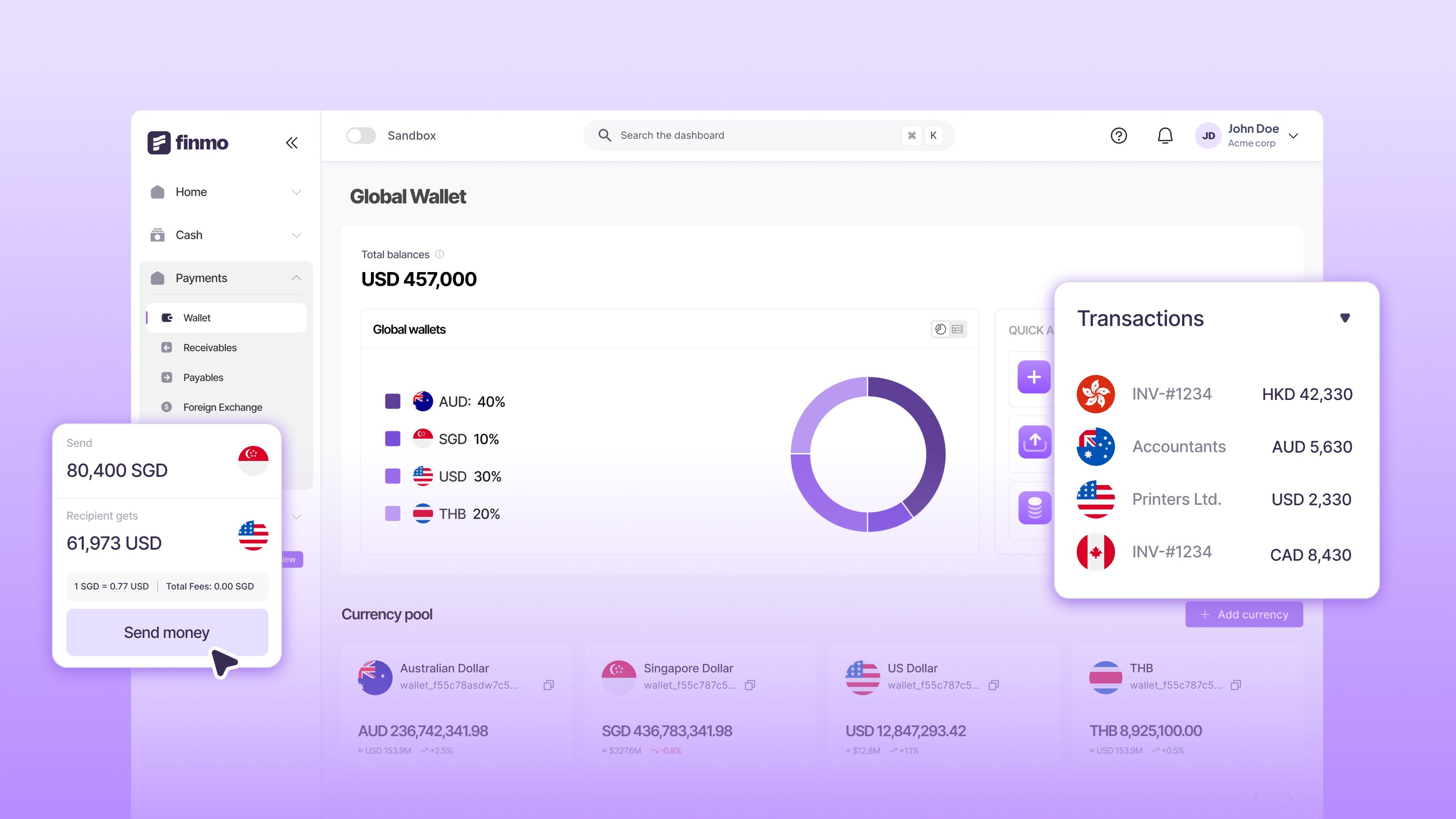
Execute global payments directly from the same system:
- Collect in 30+ currencies
- Convert anytime
- Pay out to 180+ countries
- Track the full payment lifecycle
Move from fragmented systems to connected cash intelligence, with no integration or KYB required.
FAQs
What is cash intelligence in finance?
Cash intelligence is a connected approach to managing cash, where visibility, forecasting, and payments operate within a single system. Instead of relying on separate tools and manual processes, it ensures that cash positions are visible in real time, forecasts are based on live data, and every transaction updates the system instantly.
How is cash intelligence different from traditional treasury management?
Traditional treasury systems are often complex, expensive, and built for large enterprises. They take time to implement and require structured processes that may not suit fast-growing global startups. Cash intelligence, on the other hand, is designed to be lightweight and connected. It focuses on unifying visibility, forecasting, and payments without adding operational overhead.
When should a startup invest in cash intelligence?
Startups typically start needing cash intelligence when they expand across multiple markets, currencies, or entities. If your team is already spending a lot of time reconciling data, struggling to get a clear view of cash, or relying on forecasts that are frequently inaccurate, it is a strong signal that your current setup is no longer sufficient.