From spreadsheets to strategy: Why real-time cash visibility is the CFO’s new edge

- Link copied
The CFO Role Has Changed, and So Has the World.
When I first stepped into the CFO role, my remit looked very different than it does today. Traditionally, CFOs were expected to close the books, manage audits, and ensure compliance. Vital work, but largely backward-looking. Fast-forward to 2025, and the job has transformed.
Today’s CFO isn’t just the guardian of financial accuracy. We’re growth partners, risk navigators, and decision enablers. The challenge? Balancing control and speed at the same time.
And while our role has evolved, so has the world. Businesses now operate at global scale and relentless speed from Day 1. Capital moves across borders instantly, teams work across time zones, and investors demand real-time answers. Yet many finance teams are still operating with the same fragmented tools and processes that held us back a decade ago.
Why Traditional “Data-Driven” Finance Falls Short
Finance has always been about data. Budgets, P&Ls, forecasts - they’re the lifeblood of our profession. But here’s the problem: the way we handle data hasn’t kept up with the way we run businesses.
- Data is trapped in silos: bank portals, accounting software, ERP systems, spreadsheets.
- Teams spend hours just fetching, cleaning, and reconciling numbers before they can even begin to analyze.
- By the time insights are ready, the moment for action has often passed.
This is why I believe it’s not enough for CFOs to call themselves “data-driven.” We need something more powerful: connected intelligence.
Connected Intelligence: A New Way of Working
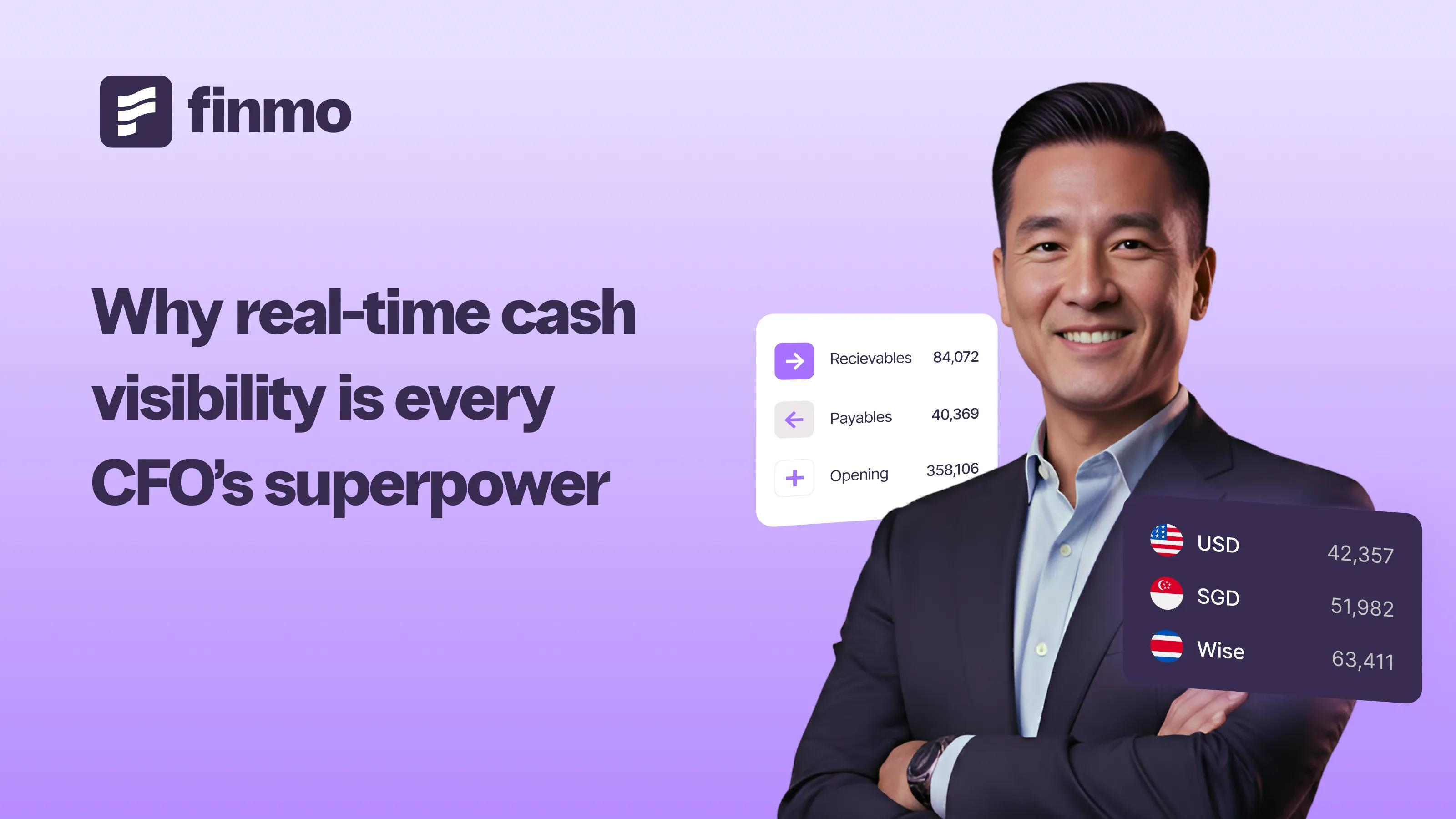
At Finmo, we define connected intelligence as the ability to automatically integrate financial data from every critical source - banks, ERP, accounting, and payment systems into a single, real-time view.
Instead of wasting time pulling statements, reformatting CSVs, and reconciling spreadsheets, connected intelligence gives you:
- Real-time cash visibility across all entities, currencies, and markets.
- Automated reconciliation so accuracy doesn’t depend on manual effort.
- Integrated controls that enforce governance without slowing down execution.
This isn’t about adding another tool to the stack. It’s about creating a single source of truth that the entire business from finance to sales to leadership can trust and act on instantly.
Lessons from Our Journey at Finmo
When I joined Finmo, we were a pre-revenue startup with ambitious goals: expand into six countries in 12 months. We had no finance systems in place, barely an invoicing engine, and certainly no consolidated data environment.
The only way we achieved that target and turned profitable along the way was by rethinking how we handled financial data. Instead of spreadsheets and manual processes, we built automated integrations that pulled live data from banks and systems, feeding into a connected treasury platform. This gave us the confidence to scale quickly while staying compliant. More importantly, it created a foundation where growth and control could coexist. What once felt impossible became manageable; not because we worked harder, but because we worked with connected intelligence.
Why Real-Time Cash Visibility Is the CFO’s Edge
Ask any CFO what keeps them up at night, and the questions are rarely tactical. They’re existential:
- Do we have the liquidity to fund expansion before competitors move?
- How exposedAsk any CFO what keeps them up at night, and the questions are rarely tactical. They’re existential:
- Are we to currency volatility or macroeconomic shocks?
- Can we generate predictable cash flow to sustain both growth and resilience?
- Are we deploying capital in the most efficient way to maximize ROI?
- Do we have the agility to pivot if markets, investors, or regulators shift overnight?
These are the questions that define the CFO’s influence in the boardroom. Yet too often they’re answered with outdated, incomplete, or siloed information, mostly a spreadsheet pulled days late, or a reconciled report that reflects the past rather than the present.
Real-time visibility changes that. With integrated data and connected intelligence, CFOs can:
- Model future outcomes with confidence: Running accurate cash forecasts within minutes, not weeks.
- Navigate uncertainty proactively: Simulating what-if scenarios around expansion, capital allocation, or market shocks.
- Uncover hidden levers of value: Identifying inefficiencies across receivables, payments, FX exposure, and working capital.
- Command strategic influence: Speaking the language of the board with forward-looking insights, not after-the-fact reports.
Real-time visibility doesn’t just make finance faster. It makes finance smarter and positions the CFO as the executive best equipped to bridge operational detail with strategic decision-making.
Building the Connected Finance Function
So how can CFOs get there? It starts with building a finance function that is connected, automated, and strategically aligned. Three practical steps stand out:
1. Automate Data Collection
Integrate directly with your banks, ERP, and accounting systems into a single connected dashboard. Eliminate manual downloads, reconciliations, and formatting exercises that drain time and introduce errors. Automation ensures your team spends less time fetching data and more time interpreting it.
2. Consolidate into a Single Source of Truth
Create connected intelligence by ensuring that finance teams, executives, and stakeholders all operate from the same real-time dataset. Yes, change management can be resource-intensive, but the payoff is lasting: alignment, speed, and credibility across the business.
3. Automate AR/AP Workflows with Embedded Controls
Operational efficiency is achieved when governance is built into processes, not added on top. Embedding approval flows, audit trails, and automated reconciliations into AR and AP workflows ensures control without slowing execution, enabling scale with confidence.
The Future Belongs to CFOs Who Embrace Connected Intelligence
The CFO’s role will only grow more complex. Market volatility, regulatory pressure, tariffs and the expectation of real-time answers aren’t going away. What will separate the CFOs who lead from those who lag is the ability to harness connected intelligence: automating the routine, integrating the fragmented, and unlocking visibility across the enterprise.
Finance has always been about data. The difference now is that with Finmo, CFOs can finally spend less time fetching it, and more time using it to shape the future of their business.
Ready to Build Your Connected Finance Function?
At Finmo, we’re helping CFOs move beyond spreadsheets and fragmented systems by delivering connected intelligence, automated workflows, and real-time cash visibility in one unified platform.
If you’re ready to spend less time chasing data and more time shaping strategy, explore how Finmo can help you build a finance function designed for growth and control.