Treasury is not payments with a dashboard
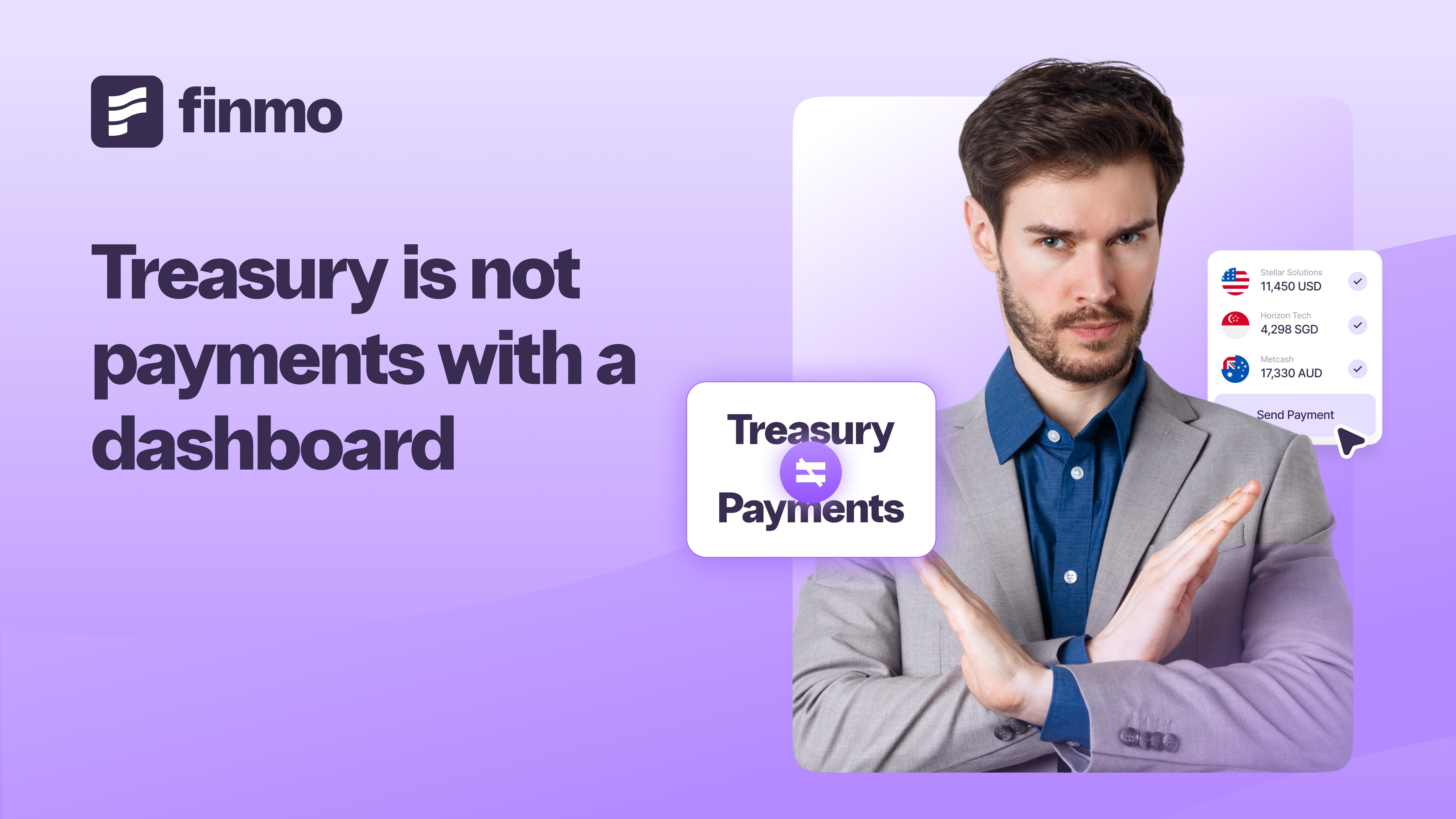
- Treasury is not payments with a dashboard
- Where the confusion starts
- Why payments professionals often struggle with treasury
- Why treasury buyers are skeptical of payment-first narratives
- The real challenge in the market
- Why does payment execution quality still matter
- Many systems, many teams, many rules - one zero tolerance policy
- What a treasury-informed standard for payments looks like
- Why Finmo is focused on building a true treasury foundation
- Why that makes Finmo better at payments, too
- Why Finmo is uniquely positioned
- Link copied
Treasury is not payments with a dashboard
Why the treasury-first distinction matters for CFOs, Treasurers, and the platforms that serve
them
Over the past several years, the word “treasury” has become one of the most popular terms in
fintech.
That should be a good thing. It reflects a real shift in the market. CFOs and Treasurers are under more pressure than ever to protect liquidity, improve visibility, manage FX and funding risk, and operate with greater precision across multiple entities, banks, currencies, and markets.
But the popularity of the word has also created confusion.
Today, many payment companies claim they offer “treasury solutions.” In reality, what they typically mean is still payments, just presented with a more sophisticated interface, a broader set of workflow tools, or a more polished dashboard.
That is a big reason why many Treasurers and CFOs have become skeptical of payment-first narratives.
They have learned, through experience, that a better payment experience only impacts a subset of a treasury operating model.
And that distinction matters more than most vendors want to admit. A “better” experience needs
to consider not only settlement speed but also risk, controls, cost, and a seamless experience.
Where the confusion starts
The confusion between payments and treasury usually stems from one basic fact:
Payments are defined transactions. Treasury considers payments and other data sources to make informed operating decisions.
A payment is easy to see. Money is sent. Money is received. A transaction succeeds or fails.
Within a corporation, payments are executed through multiple systems (e.g., ERPs, bank portals, treasury management systems, cards, HR systems). There are low-value payments, high-value payments, and payments with other risk-enhancing characteristics. This complexity must be managed with repeatable controls that ensure compliance - a tall order to manage. It is typical for Treasury to own and govern global payment policy, making it the only team in the finance organization responsible for governing a payment process it does not execute. So, when presented with payment solutions, how do they fit within Treasury’s broader mandate?
Those who equate payments and Treasury may want to reconsider their approach. Treasury is broader and often less obvious. In other words, payments are only the execution layer.
Treasury is the funding, risk management, and control layer.
A payment answers: Did the money move?
Treasury answers: Should it move, from where, in what currency, at what time, under what controls, what is the status, did it move as expected, and with what consequence for liquidity, risk, and forecast?
That distinction is critical. Payments are part of the treasury. But the treasury is much bigger than payments.
Why payments professionals often struggle with treasury
This same confusion also explains why many payments professionals have difficulty understanding treasury and, as a result, struggle to sell treasury solutions credibly.
Most payments professionals are trained to sell flow.
They focus on transaction speed, acceptance rates, routing, corridor coverage, settlement times, fee reduction, and conversion efficiency. Those are all important. But they belong to a transaction mindset.
Treasury buyers will see improvements as benefits, but are ultimately solving for something different. They are solving for risk and control.
The seller describes a better way to move money.
The buyer manages a financial system.
The seller talks about execution.
The buyer considers added risk, control of, and visibility to money movement, integration, and total cost of ownership.
That gap is not just semantic. It affects how products are built, sold, and evaluated by practitioners: a CFO managing liquidity across multiple entities, a Group Treasurer who has lived through a failed TMS implementation, or a finance lead at a fast-scaling company who has been burned by a payments tool that called itself a treasury platform.
Why treasury buyers are skeptical of payment-first narratives
Treasurers and CFOs are skeptical for good reason.
The story often sounds compelling at first: better collections, faster payouts, more rails, cross-border capabilities, smarter routing, improved user experience, and then a dashboard layered on top.
But treasury leaders quickly ask deeper questions:
- Will payments executed through a new solution still provide real-time visibility in my cash position and liquidity forecast?
- I have multiple payment systems, so will this integrate with all of them out of the box?
- Can the solution provide a real-time monitor of settlement risk within my TMS or BI tool?
- What fraud detection and AML capabilities do you offer, and how do you proactively mitigate cybersecurity vulnerabilities?
- Can I view the payment status between the time the payment is released and the time it is settled, especially for cross-border payments?
- Can I operationalize FX decisions, not just execute spot conversions?
- Can I work within a real framework of controls, approvals, reconciliation, auditability, and policy alignment?
- How will the solution reduce costs, remove risk, and increase efficiency in my operations?
If the solution can’t effectively address these questions, the product may still be valuable, but it is not a treasury solution. It is still primarily a payments solution.
That is the root of skepticism. Treasury leaders are not rejecting payments innovation. They are rejecting the idea that payments alone, even with a better interface, can solve treasury problems.
Can Treasury improve control around the timing and certainty of settlement, manage workflow and capture a full audit trail, track the status of any payment, automatically reconcile, and update its position and forecast in real-time? This is Treasury's nirvana. If payment solutions are not addressing these challenges, they are not treasury solutions.
The real challenge in the market
The broader market challenge is that payments and treasury are closely related but not interchangeable. When vendors develop solutions but don’t effectively position them for treasury, a few things happen.
First, buyers become confused. They hear “treasury” everywhere but do not always get clarity on what is actually being offered.
Second, buyers’ expectations are not well understood. A CFO may explore what appears to be a treasury solution only to discover it’s limited to transaction handling, without materially improving or addressing related needs such as visibility, liquidity management, or forecasting.
Third, trust erodes. Treasury teams become skeptical of vendors and may dismiss viable solutions.
This is why precision matters.
A strong payments capability is important. It is essential, in fact. But the treasury cannot be reduced to solely focusing on moving money more efficiently. Treasury is about managing the entire operating context around money, and payments are only one part of that context.
Why does payment execution quality still matter
None of these means that payments are a secondary concern.
Here is the part that often goes unsaid in treasury-first conversations: once a treasury function operates well, the quality of payment execution becomes even more consequential, not less.
A Treasurer who has built strong cash visibility, a disciplined 13-week forecast, and a clear FX exposure framework now faces a different and more demanding problem. The treasury decision has been made correctly. The question is whether payment infrastructure can actually deliver on it.
That is where the stakes get real.
Poor payment execution not only creates friction but also undermines trust. It creates downstream problems that ripple back into the treasury model itself:
- A payment that fails to settle on time disrupts a cash forecast built around that timing.
- A cross-border transfer routed through the wrong correspondent bank can land at a higher FX cost than anticipated, skewing a hedge.
- Limited corridor coverage can force a payment through a suboptimal rail, increasing cost and latency on a transaction that the treasury model had already priced correctly.
- A failed or delayed payroll in a high-risk market can create an entity-level liquidity shortfall that the entity was never in a position to withstand.
- Weak reconciliation infrastructure means that even a completed payment adds noise rather than clarity to the cash position.
In each case, the treasury decision was right. The payment execution let it down.
Many systems, many teams, many rules - one zero tolerance policy
Treasury sets the terms. Payments have to meet them.
A corporate payment policy governs the payment process and is defined by Treasury. The policy defines how each payment must be handled, covering a delegation of authority of approvers, segregation of duties, and workflow rules. Treasury must approve any exceptions to the policy, and teams must be able to demonstrate appropriate controls are in place. These compensating controls often generate more steps and more manual work in the process. The workflow becomes more complex due to other factors. Payment risk is not homogeneous. Domestic payments typically carry lower risk than cross-border payments, and certain countries have varying risk profiles. Country, payment amount, currency, entity, counterparty, and the systems used to process payments all generate numerous policy considerations leading to enormous complexity.
Corporations seek payment partners who can appreciate the complexity and control that is required and understand that payments don’t always follow the happy path. This is why choosing the right payments partner is a genuine strategic decision, not just an operational one. The quality of your rails, the depth of your corridor coverage, the reliability of your settlement guarantees, and the precision of your reconciliation infrastructure all determine whether treasury decisions can actually be executed as intended. Treasury will never accept solutions that they believe add risk or introduce incremental inefficiency or fragmentation to an already complex process. Articulating how a vendor’s solution can address additional concerns, such as improving controls, increasing automation, improving visibility, and integrating into the treasury ecosystems, is critical when presenting solutions to corporates.
What a treasury-informed standard for payments looks like
When treasury is the starting point, rather than an afterthought, the criteria for evaluating payment infrastructure changes substantially.
A business with a strong treasury will ask different questions of its payment provider:
- Can you settle at the time my treasury model requires, not just when it is convenient?
- Can you support the FX execution I need, at the rate, in the window, and with the confirmation speed my hedging framework depends on?
- Can you cover the corridors that matter to my entity structure, not just the popular ones?
- Can you deliver more robust data that reduces manual reconciliation and integrates cleanly into my cash position, rather than requiring manual mapping?
- Can you work within my approval and control framework, rather than around it?
- When something goes wrong, and it will, can you resolve it with the urgency a live treasury position demands?
These are not the questions that payment sellers typically hear. They are the questions that emerge naturally once the treasury is operating at a high level.
Why Finmo is focused on building a true treasury foundation
At Finmo, we have been deliberate about this distinction from the beginning. The market does not need more confusion between payments and treasury. It needs clearer thinking, more honest positioning, and products built around the real operating needs of CFOs and Treasurers.
We do not believe the treasury should be treated as a feature extension of payments. It should be built as a core financial operating layer.
That means starting with the problems finance leaders actually live with every day:
- Fragmented cash visibility across banks and systems
- Manual cash positioning and reconciliation
- Limited forward-looking visibility into cash flows
- Disconnected payment and liquidity decisions
- FX exposure managed tactically rather than systematically.
- Operational complexity across entities, markets, and rails
These are treasury problems. Payments matter within that environment, but they should be informed by treasury rather than isolated from it.
That is why Finmo’s focus is not simply on enabling money movement. It is on helping businesses achieve connected financial intelligence and control: seeing cash clearly, making better decisions, and executing payments from a position of strength.
And because we are building from the treasury layer up, the standard we hold ourselves to on payment execution is correspondingly higher. It is not enough for a payment to succeed. It has to succeed on the terms the treasury model requires at the right time, from the right entity, in the right currency, through the right rail, with data that feeds cleanly back into the cash position.
That integration is not incidental. It is the point.
Why that makes Finmo better at payments, too
This is worth stating directly: building a strong treasury foundation does not make payments less important. It makes payments better.
When treasury drives execution, the improvement is material.
A business can decide from the right account, in the right entity, in the right currency, at the right time. It can avoid unnecessary liquidity stress. It can reduce manual work and operational risk. It can align payment timing with forecasted inflows and obligations. It can treat FX as part of a broader liquidity strategy rather than a series of one-off conversions. And it can be executed with confidence, because the transaction is no longer detached from its financial context.
The same logic applies in reverse. A treasury function that operates with a poor payment infrastructure is always fighting upstream. Its decisions are sound, but its execution is unreliable. That gap erodes the value of the treasury work itself and, over time, it erodes trust in the broader financial system.
The best payment experiences in the future will not come from companies that optimize the transaction in isolation. They will come from platforms that understand the full treasury context in which that transaction sits, and that hold themselves accountable to the standards that context demands.
Better treasury drives better payments. And payment execution, done right, makes treasury decisions real.
Why Finmo is uniquely positioned
Finmo is uniquely positioned because we are not treating treasury as a label or a reporting layer. We are building it as an integrated operating system for modern finance teams.
Our view is straightforward:
- Payments should be connected to cash visibility.
- Cash visibility should connect to forecasting.
- Forecasting should inform liquidity decisions.
- Liquidity decisions should shape payment timing and funding strategy.
- FX management should be embedded into that same operating framework.
- All of it should work across banks, entities, currencies, and markets.
That integrated approach is what allows treasury and payments to reinforce one another rather than compete for attention.
That is the difference between a payment product with treasury language and a true Treasury Operating System.
This article was co-authored by Michael Kolman is the Founder of afini, a firm helping organizations improve critical finance processes using AI and automation. He has a proven history of creating value for finance teams through the effective application of technology. Michael is a Strategic Advisor to RadixEdge, an agentic AI company developing solutions for Treasury, Payments, and Commodity management. He previously served as CPO, CSO, and COO at a leading treasury fintech, advancing AI capabilities across treasury management systems.