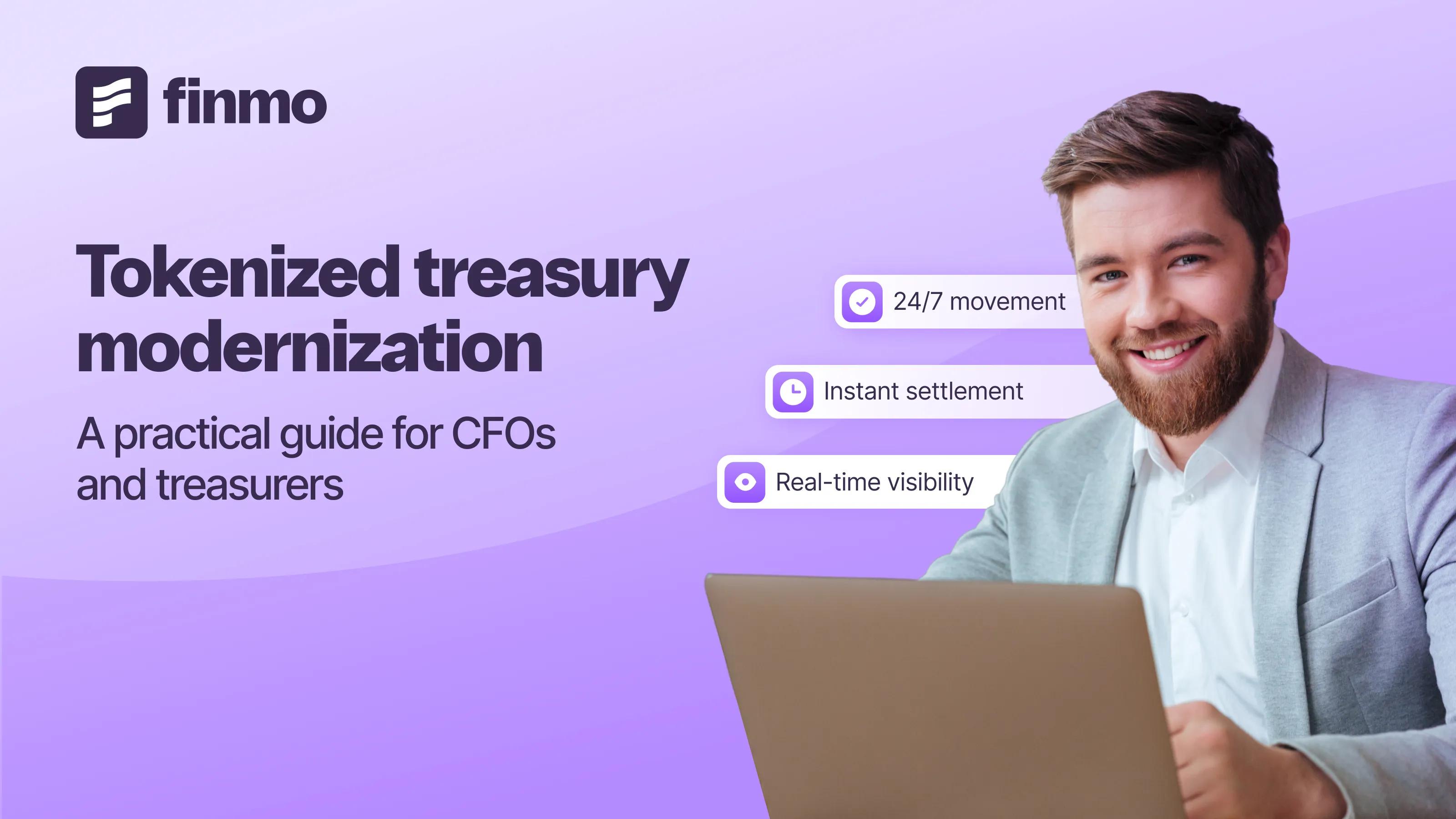
Tokenized treasury modernization: A practical guide for CFOs and treasurers
- The Strategic Value of Tokenization
- 1. Defining the Instrument: Tokenized Deposits
- 2. Fitting Tokenization into Your Existing Policy Framework
- 3. Optimizing the Hybrid Treasury Environment
- 4. The Workflow That Unlocks Real Value: Automated Cash Mobility
- 5. Risk and Controls: Questions Every CFO Should Be Asking
- 6. Infrastructure Decision: Canton vs. Private Enterprise Chains
- 7. A Phased Adoption Path: How to Evaluate This Without Overcommitting
- The Bottom Line for CFOs and Treasurers
- Link copied
Tokenization is arriving in corporate treasury, not as a speculative experiment, but as a practical upgrade to how cash moves, earns yield, and is controlled. This guide cuts through the noise for CFOs and treasurers: what tokenized deposits actually are in treasury terms, where they fit your existing cash management framework, what risks and transition challenges demand your attention, and how to think about infrastructure choices. The bottom line: tokenization won’t change your treasury strategy. But it can meaningfully improve the operating model you use to execute it, provided you navigate the hybrid transition carefully.
The Strategic Value of Tokenization
Corporate treasury relies on the pillars of liquidity, risk management, and control. Tokenization strengthens these foundations by providing a programmable movement layer for established financial instruments. This technology represents a structural upgrade to your operating model, delivering atomic settlement and 24/7 capability. In institutional applications, it serves as a movement and control layer for existing financial assets.
- Enhanced Capital Efficiency
- Tokenization eliminates the idle cash inherent in traditional payment rails.
- Real-time visibility and 24/7 operation allow you to deploy capital exactly when and where it is needed.
- This reduces the requirement for expensive liquidity buffers and maximizes yield on excess balances through automated sweeps.
2. Reduced Operational and Counterparty Risk
- Atomic settlement ensures that cash and assets move simultaneously, which removes settlement lag and associated risks.
- Programmable logic enables automated escrow and conditional releases to minimize manual error and fraud.
- Complete, timestamped audit trails provide immediate transparency into every transaction within the network.
3. Strategic Control and Programmability
- You can embed governance directly into the cash flow via rule-based triggers and automated payment instructions.
- Automation replaces manual intervention in complex workflows such as intercompany funding or margin calls.
- This allows your team to focus on strategic capital allocation rather than administrative execution.
The decision to adopt tokenization is a choice to modernize the plumbing of your organization. It is about selecting the most efficient rail to execute your existing treasury strategy and improve specific operations
1. Defining the Instrument: Tokenized Deposits
For CFOs and treasurers evaluating a first pilot, the primary instrument worth understanding is the tokenized deposit. Tokenized money market funds (MMFs) offer additional yield and collateral mobility benefits—covered briefly in Section 5—but the clearest path to demonstrating value in a Phase 1 pilot runs through the deposit layer.
Tokenized Deposits — Bank Money on a Programmable Rail
A tokenized deposit is a bank deposit liability represented and transferred via a tokenized ledger rather than through conventional payment messaging. The economics are identical to a traditional deposit: you hold a claim on the bank, the bank owes you cash, and your credit exposure is to that bank.
The difference is in the mechanics of movement and control:
| Traditional Deposit | Tokenized Deposit |
|---|---|
| Bank owes you cash; transfer via SWIFT/ACH | Bank owes you cash; IOU represented on a programmable ledger |
| Settlement subject to cut-off times and correspondent chains | Settlement within the operating domain, potentially 24/7 |
| Manual or rules-based cash management instructions | Programmable logic: conditional releases, auto-sweeps, DvP |
| Visibility dependent on bank reporting | Real-time balance visibility within the network |
What tokenized deposits are well-suited for:
- 24/7 intraday liquidity and cross-time-zone treasury operations (within the bank’s operating policy)
- Atomic settlement: using bank money as the cash leg in Delivery-vs-Payment (DvP) or Payment-vs-Payment (PvP) workflows
- Programmable treasury controls: conditional fund releases, escrow-style logic, rule-based sweeping, and automated payment triggers
What they are not:
- Risk-free. You carry bank credit exposure and are subject to the bank’s operational constraints: limits, whitelisting, cut-off equivalents, and system resilience.
- Universally real-time. Settlement is real-time only within the supported operating domain.
2. Fitting Tokenization into Your Existing Policy Framework
Most corporate treasury teams can adopt tokenization without rebuilding their policy architecture. The reason: tokenized instruments map directly onto the same two-bucket framework most treasury functions already operate in.
| Bucket 1: Operating Cash | Bucket 2: Reserve / Excess Cash | |
|---|---|---|
| Instrument | Tokenized Deposits | Tokenized MMFs (Phase 2+) |
| Primary Purpose | Move money reliably | Earn yield; preserve liquidity |
| Key KPI | Availability + settlement certainty | Liquidity + yield + NAV stability |
| Risk Lens | Counterparty limits (bank), fraud controls, operational resilience | Instrument eligibility, liquidity terms, accounting treatment |
| Governance Priority | Role-based access, maker-checker, audit trail | Custody policy, reconciliation, cash-equivalent classification |
This framing matters for a practical reason: tokenization improves the plumbing, not the strategy. Your treasury strategy remains unchanged. The only change is how efficiently you execute it, and in Phase 1, the focus should be on proving operating cash efficiency before layering in reserve cash optimization.
3. Optimizing the Hybrid Treasury Environment
The transition to a modernized treasury is rarely a “rip and replace” event. It is a phased transition rather than a disruptive replacement of existing systems, requiring the active management of the friction between high-velocity tokenized ledgers and the inertia of legacy banking infrastructure. Success requires an explicit design for this hybrid state to ensure tokenization serves as a bridge to efficiency instead of an isolated operational silo.
There are three specific challenges to plan for:
Challenge 1: Liquidity Fragmentation
Maintaining parallel pools of liquidity across traditional fiat accounts and tokenized ledgers creates a new form of “trapped cash.” The friction of off-ramping from a tokenized deposit back to legacy rails can reintroduce the very cut-off times and fees the system aims to avoid. Until atomic settlement is ubiquitous, your treasury team will essentially be managing two parallel balance sheets.
Mitigation strategies:
- Buffer Strategy: Maintain a “liquidity bridge” by keeping a calculated percentage of operating cash in traditional fiat accounts, sized to cover your peak same-day payment obligations without requiring a tokenized off-ramp.
- Just-in-Time Settlement: Use the programmability of tokenized deposits to trigger off-ramps to legacy rails only when a specific payment instruction is confirmed, minimizing the time funds sit in lower-yield traditional accounts.
- Parallel balance sheet visibility: Insist on consolidated real-time dashboards that aggregate both tokenized and fiat balances, treating them as one treasury position, not two separate systems.
Challenge 2: Workflow and Reconciliation Duplication
During a parallel run, treasury teams must manage two sets of reconciliation workflows and two distinct audit trails. Without deliberate design, this doubles the administrative burden and creates reconciliation risk at month-end close.
Mitigation strategies:
- Automated reconciliation from day one: Prioritize Phase 1 success by automating the three-way reconciliation between the token ledger, the transfer agent or custodian record, and the General Ledger (GL). Manual reconciliation at scale is not viable.
- Single audit trail design: Work with your banking partner and platform provider to ensure that tokenized transaction data flows into your existing audit infrastructure in a format your auditors recognize, not a separate, parallel record.
- Fail-back protocol: Ensure the pilot includes a documented procedure for re-routing transactions through SWIFT or local clearing if the tokenized rail experiences latency or downtime. Testing this path before go-live is non-negotiable.
Challenge 3: TMS and ERP Readiness
The target workflow described in Section 3 requires a level of system readiness that many incumbent platforms lack. Most Treasury Management Systems (TMS) and ERPs are built for batch processing and end-of-day bank statement ingestion, not 24/7 atomic settlement and continuous data streams. Integrating tokenized ledger data into your system of record is likely to require custom middleware and should be scoped as a distinct workstream.
Mitigation strategies:
- Middleware layer first: Rather than attempting a full TMS or ERP overhaul, implement a middleware or aggregation layer that sits between the tokenized rail and your existing systems, normalizing real-time tokenized balance data alongside traditional MT940/CAMT feeds. Platforms like Finmo’s Treasury Operating System are purpose-built for exactly this: providing connected financial intelligence that bridges real-time tokenized data and legacy banking feeds into a single treasurer view.
- Scope integration costs explicitly: Include TMS/ERP integration costs in your Phase 1 business case. Under-scoping the middleware layer is the most common reason tokenization pilots stall after proof-of-concept.
- Bank-hosted dashboard as interim: For Phase 1, a bank-hosted real-time balance dashboard can serve as an acceptable interim solution while the full integration is scoped and built.
The treasurers who navigate the hybrid state successfully are not those who underestimate it. They are those who design for it explicitly, treating the parallel run as a defined, time-bounded phase with clear exit criteria.
4. The Workflow That Unlocks Real Value: Automated Cash Mobility
The most compelling corporate treasury use case is the ability to automate cash mobility between operating and reserve buckets—programmatically, with governance embedded in the workflow. In traditional treasury language, this is tighter cash concentration, better intraday liquidity management, and fewer idle balances.
Target Treasury Workflow: Idle operating balances auto-sweep into tokenized MMFs (earning yield) → Redemption triggers fire automatically when needed: payment runs, margin calls, settlement windows, FX conversions, intercompany funding → Proceeds settle into tokenized deposits for immediate deployment.
The practical catch: this only works end-to-end if your ecosystem supports it. That means your banking partners, fund administrators, transfer agents, and custodians all need to operate within a compatible infrastructure, and your TMS or ERP must be able to consume the resulting data in real time. As described in Section 2, this integration layer is a real workstream, not a checkbox.
Scenario: Multinational Treasurer, Asia-Pacific Operations
A regional treasury center holds USD 50M in operating accounts across four banking partners. Historically, balances above a defined threshold sit idle overnight, missing yield due to cut-off constraints. With tokenized deposits at a participating bank and a compatible tokenized MMF, an automated rule sweeps excess balances above USD 5M into the MMF at the close of business. When the Hong Kong payment run triggers at 02:00 UTC, the redemption fires automatically, funds settle into the tokenized deposit in minutes, and the payment executes. The treasurer sees the full lifecycle in a real-time dashboard. Month-end reconciliation is automated. Manual interventions: zero.
5. Risk and Controls: Questions Every CFO Should Be Asking
Tokenization can meaningfully reduce manual processes and settlement friction. But it introduces new operational edges that require deliberate control design. Treat this like any other treasury system implementation: define your controls before you go live, test the exception paths, and ensure auditability meets audit standards.
For Tokenized Deposits (Bank Money)
Due diligence questions:
- Obligor identity: Which legal entity of the bank issues and backs the deposit claim? Does this entity carry the credit rating you’ve approved?
- Settlement finality: What does ‘settled’ mean in the bank’s framework? Under what conditions can transfers be reversed, and what is the dispute resolution process?
- Operational limits: Are there transaction limits, counterparty whitelists, or cut-off equivalents on the tokenized platform?
- Resilience and fallback: If the tokenized rail experiences an outage, what is the fallback mechanism? Is there a conventional payment route that can substitute?
Controls to insist on:
- Segregation of duties: maker-checker workflows and dual approvals for material transactions
- Role-based access management with clearly defined whitelisting governance
- Complete, timestamped audit trails that reconcile to GL entries and bank statements
On Tokenized MMFs (for Phase 2 Planning)
Tokenized MMFs offer yield on excess cash and collateral mobility benefits, but they are securities with distinct legal, accounting, and governance treatment—not deposits. Key questions for when you reach Phase 2:
- Register of record: Are tokens the official register of ownership, or a ‘mirror’ representation with the transfer agent maintaining the definitive record?
- Redemption mechanics under stress: What liquidity gates or redemption suspensions apply in stressed market conditions?
- Accounting treatment: Does this instrument qualify as a cash equivalent under your accounting policy? This varies by jurisdiction and auditor.
- Daily reconciliation across three layers: token ledger ↔ transfer agent/custodian ↔ GL
6. Infrastructure Decision: Canton vs. Private Enterprise Chains
Much of the Canton vs. private-chain-or-L2 debate comes down to one question: how many parties does your workflow need to involve?
This is an important decision for treasury teams evaluating tokenized infrastructure, but it should follow, not precede, clarity on your use case and counterparty requirements.
When a Private, Permissioned Architecture Makes Sense
Private enterprise chains (including private L2 or rollup models) tend to be the right fit when:
- Your workflow operates within a controlled domain: a single corporate group, a single banking partner, or a walled garden where you set the rules.
- Data privacy is a primary design constraint, and you want privacy by design rather than privacy through access controls on a shared network.
- You are running a workflow end-to-end with a single operator and do not need to interact with external counterparties at the settlement layer.
This is a control-first architecture. It optimizes for predictability, privacy, and operational sovereignty. The tradeoff is limited network effects and potential friction if your counterparty base evolves.
When a Network-of-Networks Architecture (like Canton) Matters
Canton’s model, privacy-preserving interoperability across participants, becomes relevant when:
- Your workflow is inherently multi-party: multiple banking partners, multiple custodians, multiple markets.
- You need synchronized transaction outcomes across applications or ledgers that belong to different operators.
- Your cash, asset, and collateral workflows span multiple institutions and cannot be consolidated under a single operator boundary.
This is an ecosystem-first architecture. It optimizes for interoperability and network effects at the cost of some degree of control over the shared infrastructure.
Decision Framework
The more your use case resembles multi-bank cash management, cross-counterparty collateral mobility, or market settlement, the more shared interoperability and standardized multi-party controls matter. The more it resembles internal liquidity orchestration within a single banking relationship, the more a private, controlled domain is sufficient. Start by mapping your counterparties before selecting your infrastructure.
A practical note on regulatory posture: both architectures are subject to evolving guidance from regulators, including the SEC, CFTC, OCC, and their equivalents in major jurisdictions. Permissioned systems operating with known, regulated participants tend to present a more straightforward compliance posture than public or semi-public infrastructure. Ensure your legal and compliance teams are engaged before finalizing infrastructure decisions.
7. A Phased Adoption Path: How to Evaluate This Without Overcommitting
Phase 1 — Prove the Operating Cash Efficiency
The primary objective of this phase is to validate the reliability of the tokenized deposit infrastructure and your team's ability to operate it in accordance with existing policy. Success here builds the institutional credibility and knowledge base required for Phase 2.
Scope: one bank partner, one corridor, one legal entity.
- Run a limited pilot for after-hours liquidity moves and intraday funding scenarios.
- Implement maker-checker controls and complete audit trails from day one.
- Deploy a middleware or aggregation layer to normalize tokenized balance data alongside existing bank feeds. Do not leave this to Phase 2.
- Test and document the fail-back protocol to legacy rails before going live.
- Measure: reduction in cut-off friction, fewer manual interventions, improved balance visibility, and reconciliation time saved.
Phase 1 success validates that the bank’s tokenized deposit infrastructure is reliable, that your team can operate it in accordance with policy, and that your system integration approach is sound. It builds the institutional knowledge base and the internal credibility for Phase 2.
Phase 2 — Scale to Capital Optimization
Once the deposit layer is stable, Phase 2 delivers the core treasury value proposition: automated cash concentration with embedded governance. This stage focuses on eliminating the yield gap by moving from idle balances to active investments.
Scope: add a tokenized MMF provider to the Phase 1 setup.
- Implement sweep rules and redemption triggers between the deposit and MMF layers.
- Build reconciliation routines across the token ledger, transfer agent, and GL.
- Confirm accounting treatment of tokenized MMF shares with your auditors before go-live.
- Measure: reduction in idle cash balances, improved investment policy adherence, and month-end close efficiency.
This phase delivers the core treasury value proposition: automated cash concentration with embedded governance. It also surfaces any remaining gaps in your reconciliation or accounting treatment framework before you scale.
Phase 3 — Capture Ecosystem Value
The final phase is where the full ecosystem value materializes through multi-bank and multi-counterparty workflows. This phase is only pursued once a solid, proven foundation exists from the previous stages
Scope: extend to multi-bank or multi-counterparty use cases.
- Explore collateral mobility use cases: pledging tokenized MMF shares against bilateral or cleared positions.
- Evaluate DvP and PvP settlement legs for tokenized asset transactions.
- Assess where multi-bank harmonization requires network interoperability. This is where infrastructure choices (Canton vs. private chain) become load-bearing decisions.
Phase 3 is where the full ecosystem value materializes. It is also where the complexity and coordination requirements increase substantially. The prerequisite is a solid, proven foundation in Phases 1 and 2.
The Bottom Line for CFOs and Treasurers
Tokenization is not a treasury strategy. It is an operating model upgrade, one that can deliver real improvements in how you move operating cash, optimize reserve cash, and govern both. But it is an upgrade that must be implemented across a hybrid environment, not a clean slate.
The framing that tends to produce good decisions:
- Tokenized deposits can modernize how you execute on operating cash objectives: better availability, more granular control, and real-time auditability.
- The hybrid transition is a real workstream: liquidity fragmentation, workflow duplication, and TMS/ERP integration are not implementation details—they are the critical path to sustainable adoption.
- The compounding value emerges when you orchestrate both deposit and MMF layers with strong governance: automated sweeping, just-in-time liquidity, and auditable workflows your audit team can actually examine.
Before any vendor conversation, write down three things in treasury terms:
- Which bucket are you targeting first? Operating cash efficiency or reserve cash optimization? Starting here focuses the evaluation.
- Which counterparties must be in scope? A single bank vs. a multi-bank changes your infrastructure requirements significantly.
- What will your auditors and systems require on day one? Define your minimum acceptable controls for approvals, custody, reconciliation, settlement finality, and data integration before you evaluate any platform.
The treasurers moving fastest on tokenization are not the ones chasing the most innovative technology. They are the ones who have been most disciplined about defining their treasury requirements first and who have planned explicitly for the hybrid state they will inevitably operate in during the transition.