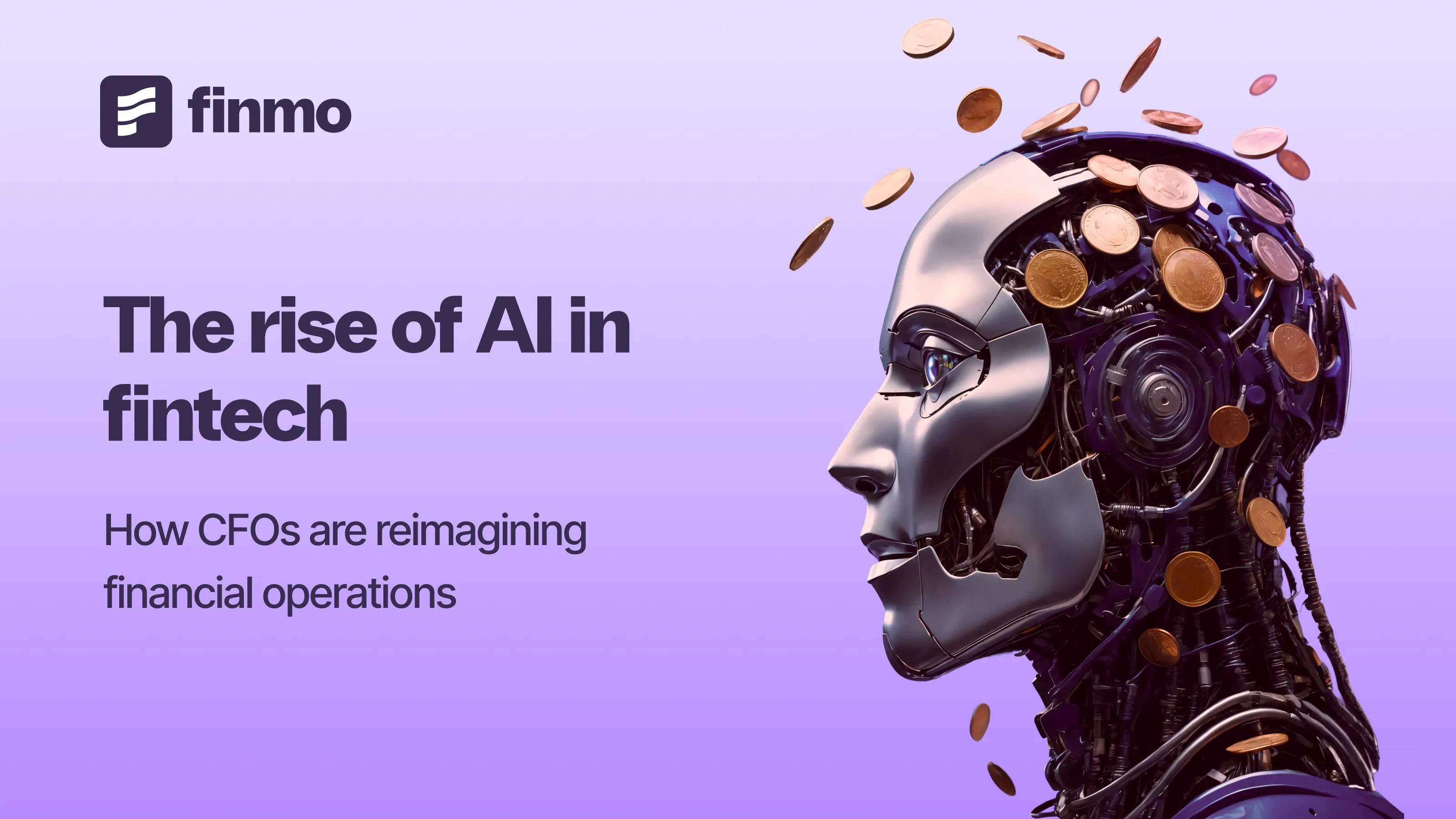
The rise of AI in fintech: How CFOs are reimagining financial operations
- Link copied
AI adoption in financial services increased from 58% in 2022 to over 75% in 2024.
And this increase isn’t surprising at all.
CFOs and finance teams are now dealing with more data than ever, and they are under more pressure than ever to reconcile faster, forecast better, and keep liquidity visible across all global entities.
AI has become the silent engine driving this change. By processing data and identifying trends in real time, AI helps finance teams improve cash flow, manage risks, and plan ahead with confidence.
Let’s take a look at where AI is creating a massive impact in finance–and how Finmo brings that power into the CFO’s daily workflow.
Where AI creates the most impact in financial operations
1. Automated reconciliation
For many finance teams, reconciliation remains one of the biggest drains. In Singapore, 75% of SMEs say that reconciling payments is a significant challenge. On average, medium-sized businesses spend up to 7 hours a week just on reconciliation.
AI changes that by matching transactions, invoices, and bank feeds in real time and automatically identifying discrepancies and anomalies. For CFOs, that means fewer manual checks, faster month-end closes, and a cleaner audit trail.
2. Fraud detection and risk management
As financial operations become faster and more digital, fraud prevention has to evolve in real time.
AI-driven systems can now analyze billions of data points, from transaction histories to user behavior patterns, to identify and stop anomalies before payments even go through.
For instance, J.P. Morgan Chase reported that AI-driven payment validation screening led to a 15-20% reduction in account validation rejection rates and significant cost savings. JP Morgan also uses AU to automatically show insights to their clients when they need them.
Similarly, EY found that AI improves risk management by detecting fraud patterns earlier, resulting in fewer defaults and lower risk provisions.
For CFOs, this translates to stronger financial controls, faster issue resolution, and a measurable reduction in operational risk.
3. Cash flow forecasting and liquidity planning
Forecasting accuracy has long been a challenge for finance teams. AI models can now process live ERP data, bank transactions, and external data such as FX fluctuations or payment trends to project inflows and outflows dynamically. CFOs gain early visibility into shortfalls and can take action before problems arise.
In fact, according to McKinsey, AI-powered forecasting models have been shown to reduce error rates by up to 50% compared to traditional spreadsheet-based analytic methods.
Beyond prediction, AI’s real-time data integration and pattern recognition give CFOs a complete view of liquidity. Machine learning algorithms aggregate structured and unstructured data from ERP, CRM, and market feeds, while natural language processing (NLP) can extract insights from news, social media, and regulatory updates to anticipate changes in cash flow.
AI also enhances scenario simulation and stress testing. Instead of relying on a handful of predefined models, AI can generate thousands of scenarios–simulating events like currency devaluation, customer defaults, or supply chain disruptions.
The challenges of AI in Fintech
For all its promise, AI adoption in finance is not without complexity. Here are the key challenges of implementing AI in your finance operations:
- Data privacy and security: Financial data is among an organization’s most sensitive assets, often distributed across global entities and regulatory environments. Maintaining compliance while leveraging AI’s analytical power requires governance and tight access controls.
- Ethical AI: One of the subtler risks in AI adoption is algorithmic bias–when models unintentionally favor or disadvantage certain outcomes because of the data they were trained on. In a financial context, that could mean inaccurate risk assessments, uneven payment prioritization, or misleading liquidity predictions. For CFOs, the risk is both strategic and reputational. Ensuring fairness in AI systems is a compliance requirement and very crucial for responsible financial management.
- Cultural and strategic dimension: Many finance teams have spent years refining spreadsheet-driven workflows, so introducing AI can feel disruptive if not properly managed. The challenge lies in helping teams understand that AI is not replacing their expertise, but amplifying it by taking over repetitive tasks so they can focus on strategic analysis and decision-making. When teams see AI as a trusted partner rather than an external system, adoption becomes smoother and its impact more meaningful.
How Finmo embeds AI into everyday finance
Finmo acts as your finance command centre–consolidating payments, FX, AR/AP, bank accounts, analytics, and forecasting into one connected platform. By integrating directly with your global bank accounts, ERPs, and accounting systems, it unifies financial data across currencies, entities, and regions.
This connected intelligence eliminates manual reconciliations and fragmented reporting, giving CFOs instant visibility and actionable insights. As a result, they spend less time chasing numbers and more time driving growth.
Here’s how Finmo is using AI to transform financial operations:
Smarter cashflow forecasting and analytics
Finmo’s AI-powered forecasting engine replaces that lag with automation, precision, and continuous learning.
- Predictive insights: Finmo can analyze historical payment patterns, account balances, FX rates, and market movements to project future cash flows with greater accuracy.
- Scenario simulation: Finance teams can instantly model ‘what-if’ situations (such as delayed receivables and currency volatility) to test the liquidity resilience of the company under multiple conditions.
- Continuous updates: Real-time data feeds ensure forecasts automatically adapt as transactions, markets, and business conditions evolve.
Conversational finance with MOAI
At the heart of Finmo’s intelligence lies MOAI–our conversational AI assistant that transforms how finance teams interact with data.
- Ask, don’t search: Instead of digging through reports or dashboards, just directly ask MOAI about your business’s numbers and projections–whether it's last week’s outflows by currency or projected liquidity next quarter. MOAI understands and responds with precise, contextual insights.
- Act faster: Beyond analysis, MOAI can trigger payments, initiate transfers, or generate reports, all from within the same chat interface.
- Learn and adapt: Over time, MOAI learns user behavior and context, tailoring insights and actions to each finance leader’s preferences.
Streamlined KYB with Trulioo
Compliance has traditionally been a bottleneck for finance operations as it can be slow, manual, and error-prone. Finmo removes that friction by integrating with Trulioo, a leading global identity verification platform.
Through Trulioo’s AI-driven verification engine, Finmo automates:
- Identification & Verification (ID&V), including facial biometric validation
Company report extraction and validation for Know Your Business (KYB) processes
This automation eliminates manual document handling, accelerates onboarding, and strengthens compliance, even across highly regulated markets.
Bring AI to your finance operations
See how Finmo helps CFOs turn complexity into control with smarter forecasting, automated reconciliation, and intelligent liquidity management.